
Double Roughwater Swim
- Oct 10, 2026
- Last edition date
- Distance: 7km
At a glance
- Last edition date
- October 10, 2026
- Distances
- 7 km
- Where
- Sea · Waikiki Bay, Honolulu, HI, United States
- Entry fee
- 140 USD
- Wetsuit
- Wetsuits are not necessary due to warm water temperatures. The event follows FINA open water standards; floatation is not encouraged. Swimmers are limited to suit, cap, and goggles.
- Registration
- longdistanceswim.com
About the race
The Double Roughwater Swim is an open water swimming event covering seven kilometers in the Pacific Ocean along Waikiki Bay, in Honolulu on the island of Oʻahu. Founded in 1980 by Jim Anderson, the race was established to extend the open water swimming calendar well past the traditional summer season. The out-and-back course departs directly from the sand, tracing the outer bay to round the Ala Wai Harbor channel buoy before guiding swimmers home to the very beach where they started. Safety on this open ocean course relies entirely on an individual escort for every swimmer, paddling alongside on a surfboard, paddleboard, or kayak, while motorized boats and propellers are strictly banned.
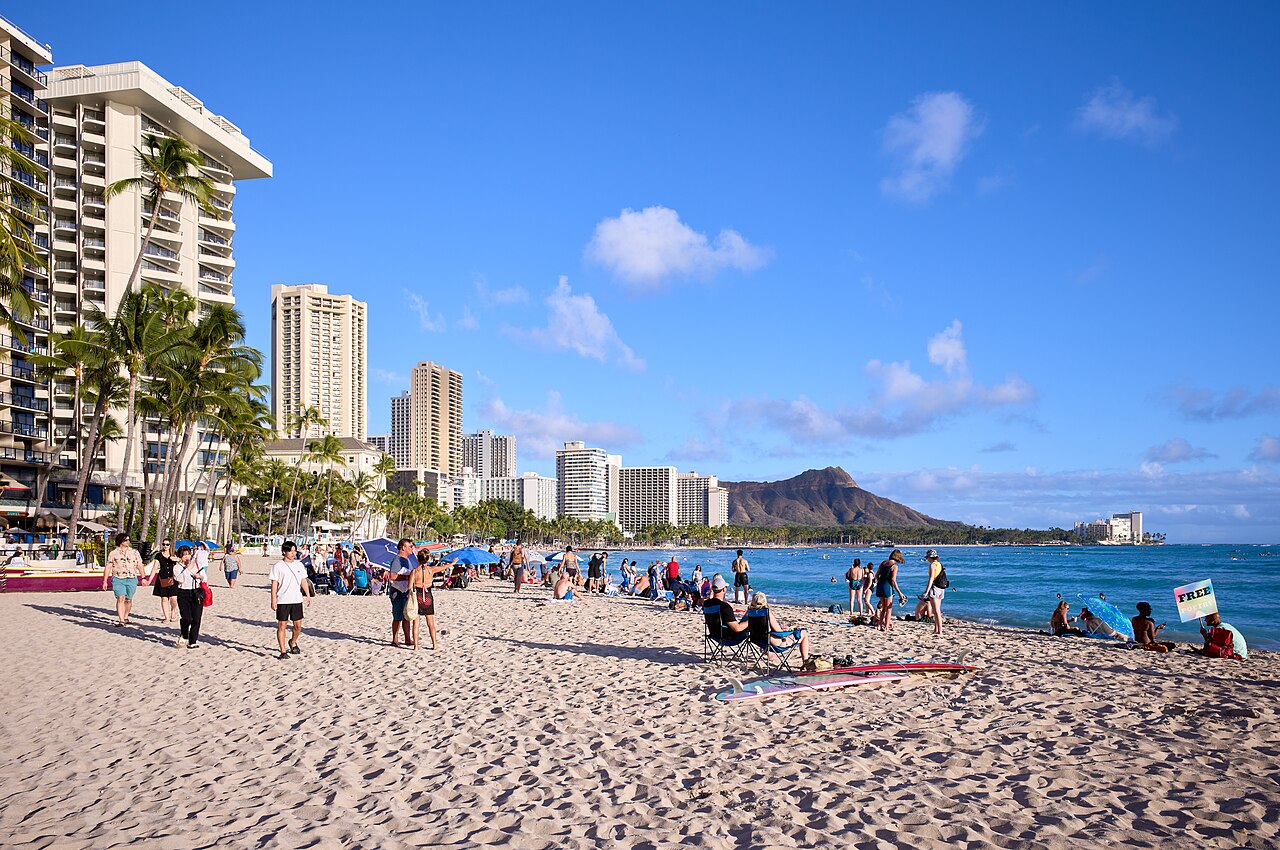
Traditional open water swimming customs govern the day, limiting gear to a textile swimsuit, silicone or latex cap, and goggles, without the use of flotation aids. Swimmers complete the seven kilometers and earn official finisher status. Because the deep-water path features no lane markers or intermediate course buoys, swimmers must read the moving sea under natural open conditions. Currents in Waikiki Bay flow in shifting directions, creating a balanced test where the ocean tends to assist swimmers for one half of the journey and push against them for the other. In past editions, a neutral ocean current on the outbound stretch has been met by stiff head winds on the long swim home to Kaimana. Once across the finish line, participants gather at the Outrigger Canoe Club for a celebratory post-race meal and awards ceremony.
Diamond Head: Volcanic crater and coastal defenses over Waikiki
In 1908, military engineers built a steep trail to the crater summit as part of the coastal defense system, utilizing the heights as an elevated strategic lookout over the entire south shore of Oahu. The Diamond Head Lighthouse first operated atop a 40-foot iron framework enclosed by coral rock walls before being replaced in 1917 by a 55-foot reinforced concrete tower set upon the original base. During World War II, the United States Coast Guard ran a coastal radio post at the lighthouse grounds. When the assault on Pearl Harbor began, the on-duty radio operator broadcast urgent emergency warnings directly to civilian boats cruising offshore.
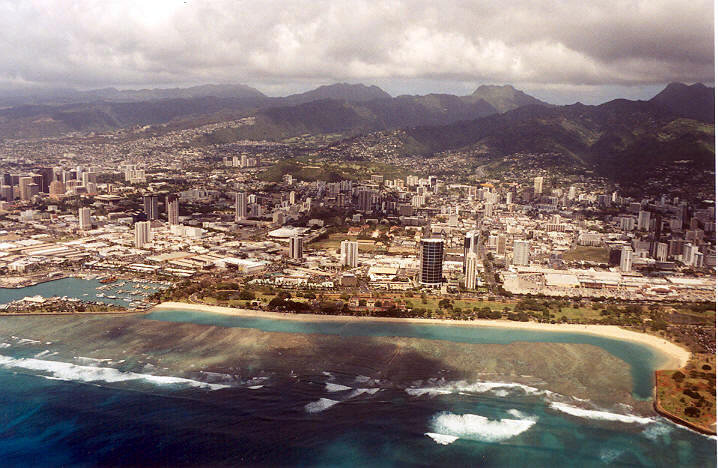
The shores of Waikiki: Royal fleets and sacred healer stones
Foreign ships first anchored in Honolulu Harbor in November 1794, when Captain William Brown of Great Britain navigated into Honolulu Harbor. The surrounding waters carry deep royal history, as King Kamehameha I assembled an invasion fleet of 1,200 war canoes in 1795 to conquer Oʻahu, landing his army along the sands of Waiʻalae and Waikiki. During the campaign, local warriors recaptured several vessels while anchored off Waikiki before retreating inland during the decisive struggle. Just along the coastline at Kūhiō Beach Park, four ancient basaltic boulders known as the Stones of Life stand as a monument honoring legendary Hawaiian healers. The surrounding shoreline once served as Pualeilani, the private ocean estate belonging to Prince Kūhiō and Princess Elizabeth Kahanu. In July 1918, Prince Kūhiō knocked down his high timber estate fence, opening the semi-protected beach waters permanently to the public for swimming and recreation.
The historic oceanfront: From the Moana banyan to the Royal Hawaiian
Built with wide, oceanfront lānais to capture the Pacific breeze, the Moana Hotel long embraced ocean sports, with the Prince of Wales famously diving into the waves from its private pier in 1920. In the hotel courtyard, an Indian banyan planted in 1904 now spreads 150 feet across and towers 75 feet tall, preserved as an official Hawaii Millennium Landmark Tree. The sound of waves breaking on the sand was broadcast during broadcasts of Hawaii Calls. During the Pacific campaigns of World War II, the Royal Hawaiian Hotel was requisitioned by the military, and access to the ocean was sealed behind barricades of concertina wire strung directly across the sand. Today, those once-restricted beaches open seamlessly to the warm Pacific swells.
Ala Moana and Magic Island: The dredged coral channel
In the late 1920s, a 1,000-yard boat channel was dredged straight through the shallow coral reef to link Kewalo Basin with Ala Wai Harbor, creating a 20-to-30-foot-deep corridor that later evolved into a popular swimming fairway. The channel bottom transitions from fine white sand on its eastern stretch to scattered natural rocks on the middle and western reef floor. Protecting the outer curve of the channel is Magic Island, a 30-acre man-made peninsula created in the 1960s by reclaiming shallow reef flats. Kewalo Basin is an active commercial harbor serving Honolulu's working fishing fleet and marine tour craft. A small beach park sits on the ocean side of the harbor. With ocean temperatures in Honolulu remaining warm year-round, swimming through Waikiki's deep blue waters makes for a pure, unobstructed journey along one of the Pacific's most celebrated coastlines.
Sources: Honolulu · Ala Moana Beach Park · Kewalo Basin · Magic Island (Hawaii)
Course
An open ocean out-and-back course in the Pacific Ocean, starting and ending on the same beach in Waikiki Bay. Navigation is a critical skill as real-world distance can exceed 7km depending on conditions and currents.
Awards
- Age group awards
Male and female age divisions: 24 and under, 25-29, and five-year increments thereafter.
Previous editions
- 2024results
How to get there
Double Roughwater Swim
Frequently asked questions
- When was the last edition of Double Roughwater Swim?
- The last edition of Double Roughwater Swim took place on October 10, 2026.
- What distances does Double Roughwater Swim offer?
- Double Roughwater Swim has a single distance: 7 km.
- How much is the entry fee for Double Roughwater Swim?
- The entry fee is 140 USD. Registration closes Oct 8, 2026. Additional $15.30 processing fee applies at checkout.
- Is a wetsuit required at Double Roughwater Swim?
- Wetsuits are not necessary due to warm water temperatures. The event follows FINA open water standards; floatation is not encouraged. Swimmers are limited to suit, cap, and goggles.
- Where does Double Roughwater Swim take place?
- Double Roughwater Swim is a sea swim. Location: Waikiki Bay, Honolulu, HI, United States.
- How do I register for Double Roughwater Swim?
- The reference page for registering for Double Roughwater Swim is https://longdistanceswim.com/.
Where to stay
Waikiki offers a high density of lodging, ranging from traditional beachside high-rise resorts to smaller boutique hotels located near the Ala Wai Yacht Harbor. Expect to find standard hotel rooms starting at $250 per night, with premium beachfront suites exceeding $500. For those preferring a more local atmosphere, smaller inns near the Kaimana Beach area provide easier access to the race start. Booking in advance is recommended, as October remains a active time for local water sports events.
Things to do nearby
Beyond the race, the Honolulu waterfront is a hub for ocean-based recreation. Visitors can book kayak or SUP rentals to explore the calm waters within the protective reef at Ala Moana Beach Park. For those interested in the cultural history of the island, trekking to the summit of Diamond Head provides a panoramic view of the swimming course, while the nearby historic sites and food tours in the Waikiki district offer deeper insight into the local salt-production heritage and coastal traditions.
Swimmers
Similar races


Comments
Transparency: some links on this page (stays, flights, experiences, gear) are affiliate links — if you book or buy through them, Omniathlon may earn a commission from the partner at no extra cost to you. As an Amazon Associate we earn from qualifying purchases.