
Hamburger Freiwasserschwimmen
- Distances from 1km to 3.8km
At a glance
- Distances
- 1 km · 2.5 km · 3.8 km
- Where
- River · Regattastrecke Allermöhe (Dove Elbe), Hamburg, Germany
- Registration
- hamburg-freiwasser.de
About the race
In Allermöhe, racing shells and canoes yield their lanes once an August to hundreds of open-water swimmers. The Hamburger Freiwasserschwimmen is an open water swimming race held in the Dove Elbe river branch at the Regattastrecke Allermöhe in Hamburg, Germany. Organized by the Hamburger Schwimmverband e.V., the summer weekend brings the calm rowing course to life with distance swimmers. The same regional association also organizes the Wandsbeker Seeschwimmen Ostende across town. Swimmers can take on distances of 1,000 m, 2,500 m, and 3,800 m laid out along the surveyed regatta lanes. In past editions, recreational Jedermann competitors in the 1,250 m event started five minutes behind the licensed swimmers, while the 2.5 km races drew a competitive field dominated by the Hamburg Masters squad.
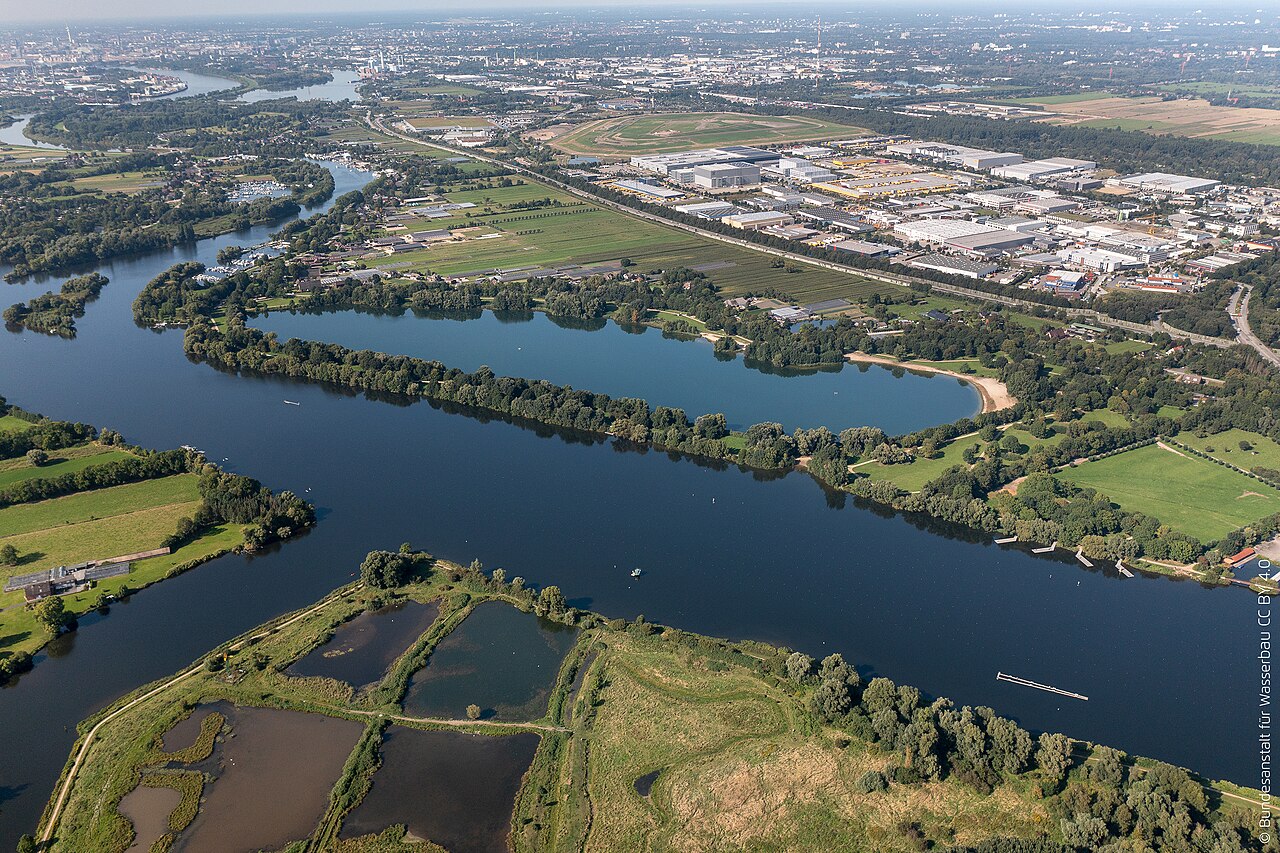
The schedule often culminates in an energetic 3x1.25 km mixed relay. Team spirit runs high, and during one edition the Hamburger SC entered eight separate relay squads, leaving swimmers waiting at the handover wondering whether an incoming competitor belonged to their own team. Recreational heats launch directly from the water, with participants holding on to a floating pontoon before pushing off at the sound of the starting signal. Those opening strokes away from the pontoon can feel intense, as swimmers jostle for position, clash elbows, or risk losing their goggles in the churn. Any opening anxiety quickly subsides, as recreational swimmers are permitted to wear wetsuits even when water temperatures climb above 20 °C (68 °F), keeping everyone comfortable.
While the deep water can seem intimidating from above—prompting one participant in 2012 to swim backstroke just to avoid looking down into the darkness—the Dove Elbe was measured at an inviting 20 °C (68 °F) that year. After the first lap, the field strings out evenly across the wide channel. Competitors find their stroke across multiple laps, sharing the water in what swimmers describe as a relaxed and cheerful atmosphere.
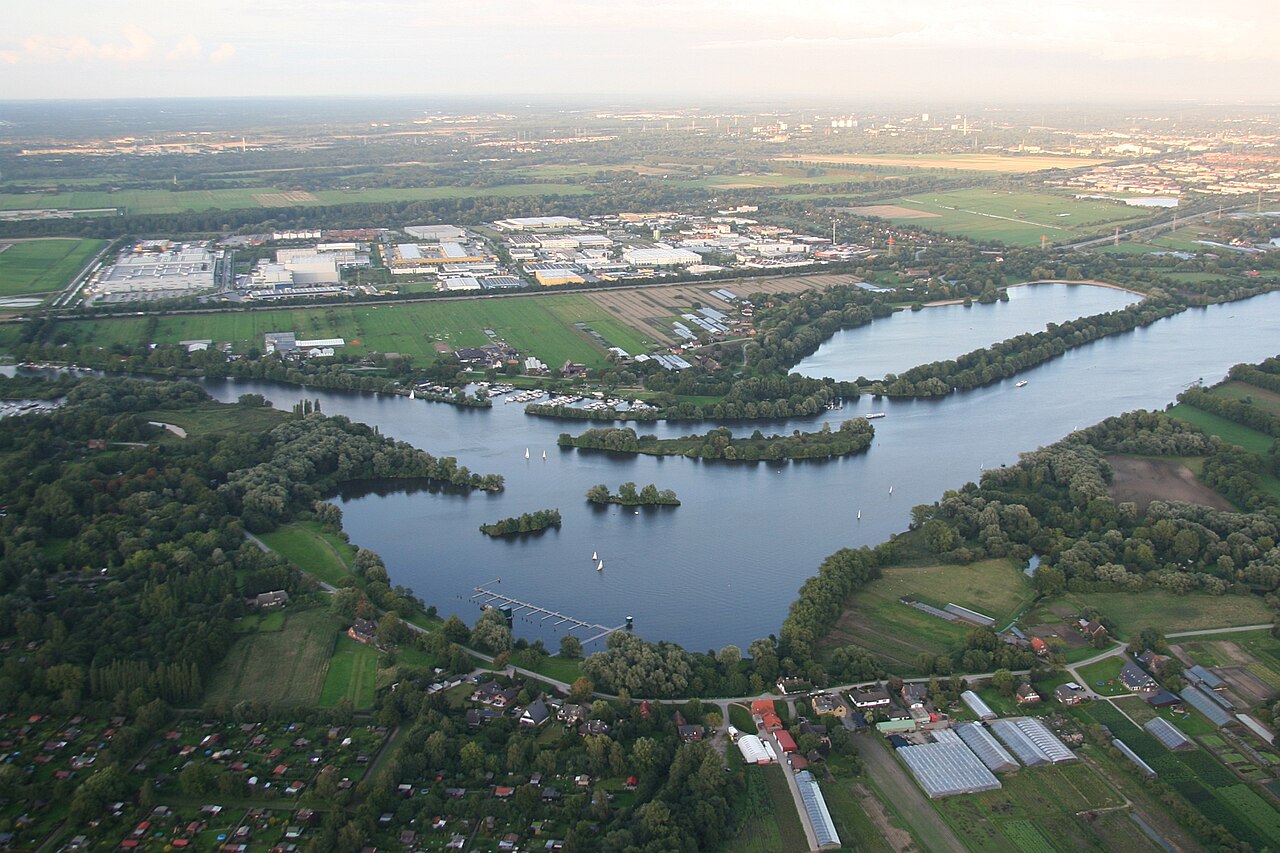
Allermöhe marshlands and waterside camping along the basin
The flat marshland surrounding the Allermöhe regatta course presents a tranquil side of Hamburg, situated far from the bustling Reeperbahn and the city fish market. Broad water views and quiet banks replace the city traffic, creating a calm retreat right along the racing channel. For competitors travelling to the event, the organizers open the grounds beside the water for camping on race weekend. Staying in a tent on site puts you just steps away from the start, letting you wake up on the water's edge.
The medieval dikes of the Dove and Gose Elbe
The sheltered water of the regatta basin belongs to the Dove Elbe, an ancient anabranch of the lower Elbe river. A medieval dike cut off its inflow from the main river in 1438, and a redirection of the Norderelbe shortened the river's lower end in 1579. Nearby flows its sister channel, the Gose Elbe, which was separated from the main Elbe around 1390 by a dike built between the islands of Kirchwerder and Neuengamme. The Gose Elbe follows a very winding course characterized by broad banks and sweeping meanders. Because the waterway lacks any significant gradient and twists through many bends, its current is extremely weak. About five kilometres from the regatta course, the dammed Dove Elbe connects with the Bille river through the Schleusengraben.
Excavated centuries ago, the Schleusengraben is one of the oldest artificial waterways in Germany. Water transit between the rivers has been regulated since 1929 by the Krapphofschleuse lock. In the weir arm east of the lock, under a road bridge, paddlers can use a dedicated boat portage to transfer canoes past the weir.
Bunthäuser Spitze and the historic beacon on the Elbe
About four kilometres from the race area, the main Elbe splits into the Norderelbe and Süderelbe at Bunthäuser Spitze, forming an inland delta. The Süderelbe runs deeper and shorter than the northern branch, channeling 55 percent of the river's water volume while the Norderelbe carries 45 percent. To manage the riverbank reinforcements around this major fork, the Stackmeisterei Bunthaus was established in 1847. Since 1977, ultrasonic flow measurement systems using cross-path sound sensors angled at 45 degrees have replaced manual methods to monitor water velocity continuously. To mark the separation of the shipping lanes, a green hexagonal wooden lighthouse measuring nearly seven metres in height was built at Bunthäuser Spitze in 1913, entering service in 1914. The Bunthaus beacon operated until March 1977, when its navigational role was replaced by a system of red and green buoys.
Die Reit and Kiebitzbrack in the Vierlande wetlands
About six kilometres from the regatta grounds lie the Neuländer Moorwiesen, where marsh cultivation began in 1296 under Duke Otto II of Braunschweig-Lüneburg through dikes and drainage ditches. Covering 62 hectares, the Hohendeicher See was designated a landscape protection area in 1977. Its water hosts bird life such as mute swans, coots, great crested grebes, and mallards, alongside American crayfish and fish including carp, tench, pike, zander, and eel. About eleven kilometres away, the maritime story reaches the Speicherstadt, a 1.5-kilometre warehouse district built on oak log foundations and crisscrossed by tidal canals called Fleets. Its construction began in 1883 with the demolition of the Kehrwieder and Wandrahm districts, creating historic structures like Kaispeicher B with loading portals accessible from both land and water. Although bombing in World War II destroyed roughly half the buildings, the restored waterfront warehouses showcase Hamburg's enduring connection to the river network.
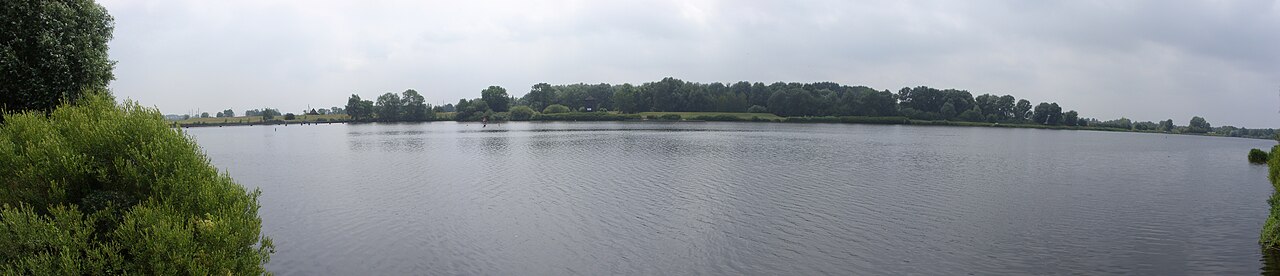
Course
How to get there
Hamburg Airport (HAM) is 10km away. The central station (Hamburg Hbf) is well connected. The race venue is accessible via S-Bahn (lines S1/S3) or city buses. Parking is limited in the city center; the use of public transport or Park & Ride (P+R) facilities outside the city is recommended.
Hamburger Freiwasserschwimmen
Frequently asked questions
- What distances does Hamburger Freiwasserschwimmen offer?
- Hamburger Freiwasserschwimmen offers 1 km, 2.5 km, and 3.8 km.
- Where does Hamburger Freiwasserschwimmen take place?
- Hamburger Freiwasserschwimmen is a river swim. Location: Regattastrecke Allermöhe (Dove Elbe), Hamburg, Germany.
- How do I register for Hamburger Freiwasserschwimmen?
- The reference page for registering for Hamburger Freiwasserschwimmen is https://www.hamburg-freiwasser.de/.
Where to stay
Hamburg offers diverse lodging, ranging from historic boutique hotels on the harbor front to functional guesthouses near the city center. You will find converted traditional warehouses turned into modern stays, as well as camping sites located along the outskirts near the river meadows. Expect to pay between €120 and €250 per night for a standard double room in the city, with lower rates available for camping or hostels further from the central districts.
Things to do nearby
Beyond the race, the city invites exploration through its maritime heritage and canal networks. You can rent a kayak to navigate the narrow Fleete (canals) that thread through the city, or join a guided walking tour of the historic Speicherstadt district. Tasting local seafood at the harbor or visiting the Elbphilharmonie provide cultural depth to your visit. For those seeking fresh air, the marshlands offer extensive trails for trekking, while the nearby lakes provide opportunities for sailing or stand-up paddleboarding.
Swimmers
What to see around
1. Speicherstadt (UNESCO World Heritage Site), 2. Miniatur Wunderland, 3. Hamburg harbor boat tour, 4. Elbphilharmonie (panoramic view), 5. Planten un Blomen park for running or relaxation.
Other races by this organiser
- Wandsbeker Seeschwimmen OstendeHamburg, DE
Similar races


Comments
Transparency: some links on this page (stays, flights, experiences, gear) are affiliate links — if you book or buy through them, Omniathlon may earn a commission from the partner at no extra cost to you. As an Amazon Associate we earn from qualifying purchases.