
IOWT Traversata delle Eolie — Vulcano
- Oct 17, 2026
- Last edition date
- Distances from 500m to 6km
At a glance
- Last edition date
- October 17, 2026
- Distances
- 500 m · 926 m · 1.9 km · 3 km · 6 km
- Where
- Sea · Vulcano, Sicilia, Italy
- Entry fee
- 20–55 €
- Registration
- italianopenwatertour.com
About the race
Open water swimmers navigate without artificial reference lines, taking their bearings directly from sea stacks of solidified magma. This is the setting for the IOWT Traversata delle Eolie — Vulcano, an open water swimming race held in the Tyrrhenian Sea off the island of Vulcano in the Sicilian Aeolian archipelago. Organized by the Italian Open Water Tour, the competition serves as the final stage of the tour and its season challenge. The competition features five distinct races suited to different distances and styles: the 6K Hard Swim, the 3K Super Smile Swim, the 1.8K Smile Swim, a 900-metre by three-leg Relay Swim, and a 500-metre breaststroke sprint known as La Gara Impavida.
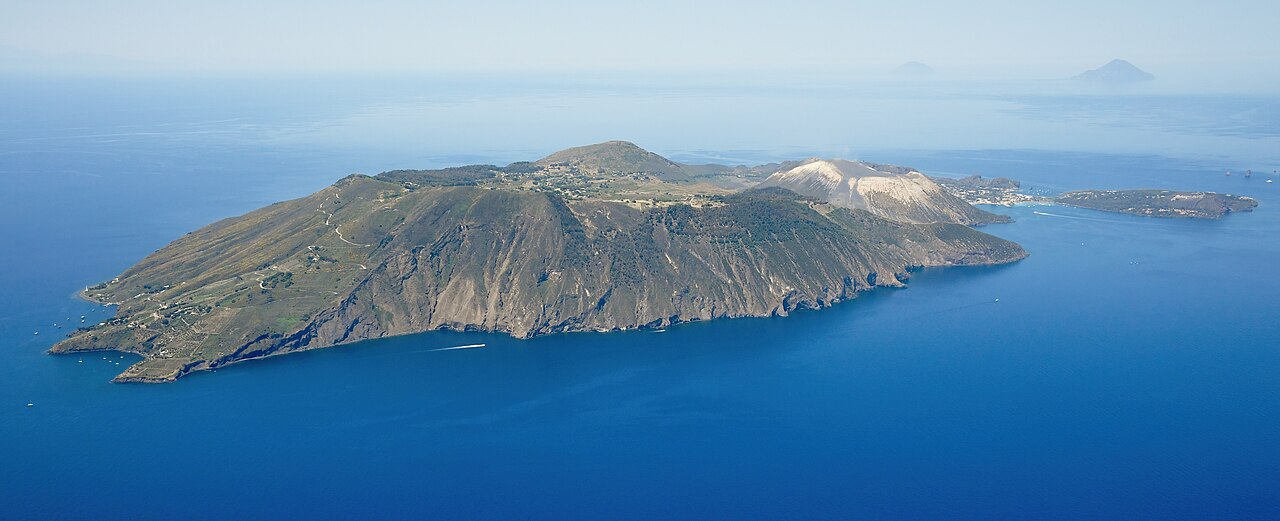
The courses turn the surrounding volcanic geography into natural navigational beacons, taking competitors past an offshore sea stack and beneath the gaze of the active volcano. In past editions, the Hard Swim course led swimmers through a scenic passage directly in front of the Lipari sea stacks. Autumn conditions in the bay can be astonishingly calm, with past swimmers describing the sea as a dream where the water forms a glass-like mirror reflecting the volcanic slopes. The crossing has inspired moving team performances, including two swimmers who tackled and completed the entire 6000-metre Hard Swim tethered together by a 50-centimetre rope. The racing schedule draws to a close with La Gara Impavida, an ironic 500-metre breaststroke dash where competitors celebrate at the finish with an aperitif of cold beer. As evening arrives, swimmers and organizers gather on the black volcanic sand beach of Vulcano for a sunset party to celebrate the close of the tour.
Gran Cratere and Vulcanello: the volcanic waters
The island of Vulcano owes its existence to the immense tectonic collision of the African plate driving into the Eurasian plate. This subduction created the Aeolian volcanic arc across the southern Tyrrhenian Sea, part of an extensive underwater mountain system that includes the submerged peaks of Marsili and Palinuro. The Gran Cratere della Fossa forms a vast volcanic bowl spanning approximately 500 metres across. The volcano’s last explosive eruption concluded in 1890. Heat still pulses through the slopes, where surveys of groundwater wells along the volcanic flanks recorded intense thermal warmth rising from the depths. Vulcanello is a low lava plateau shaped by multicolored volcanic tuffs. Vulcanello originally erupted from the sea as an isolated islet in 183 BCE. It remained separated from the main island for centuries until a final eruption in the 16th century laid down a 300-metre sandy isthmus that permanently joined the two landmasses.
The Faraglioni of Lipari: volcanic necks in the strait
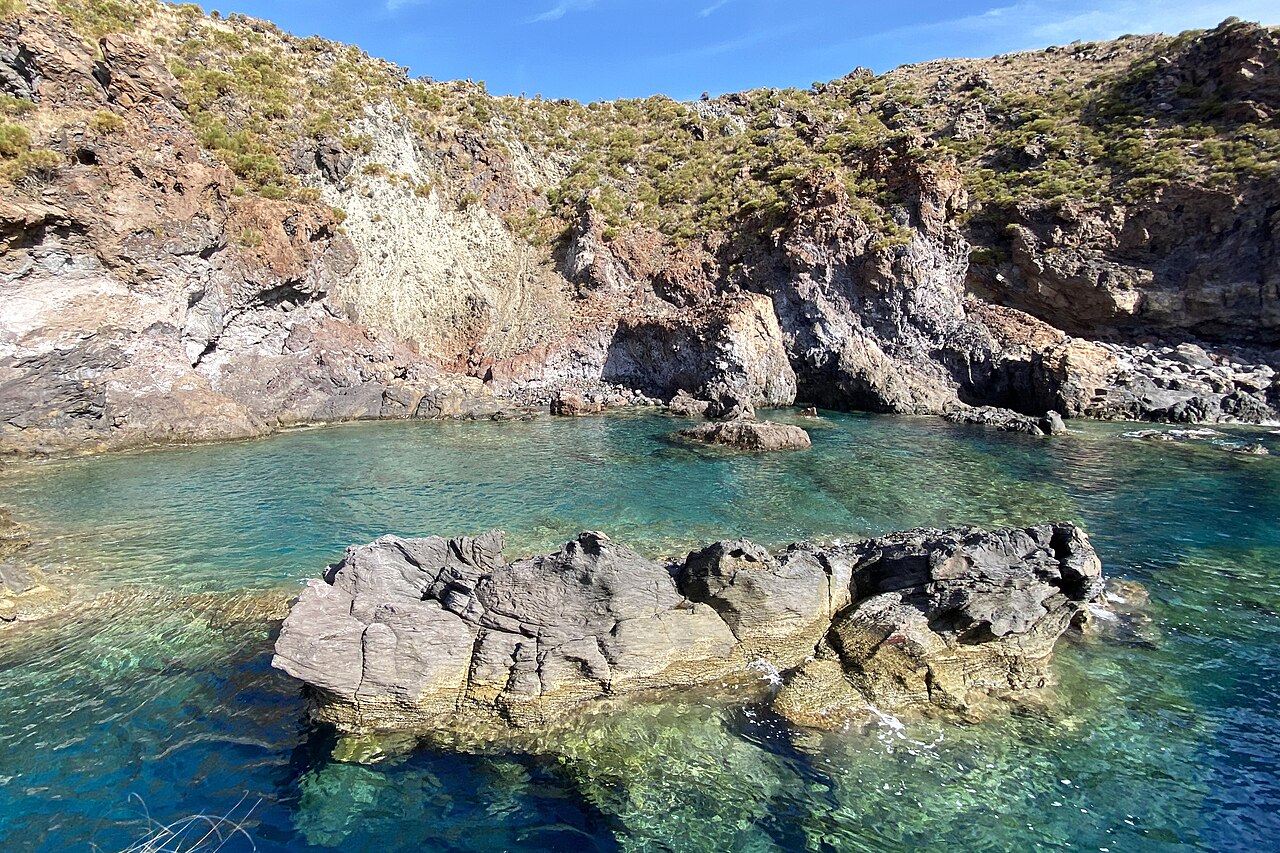
Across the strait separating Lipari and Vulcano stand the Faraglioni of Lipari, two isolated rock formations named Pietra Lunga and Pietra Menalda. These towering sea stacks are volcanic necks, the fossilized cores of ancient vents where magma solidified inside volcanic chimneys. Sheer pillars of dense rock rise vertically out of deep blue water. According to ancient literary tradition, these monoliths correspond to the legendary Wandering Rocks described in Homer’s Odyssey. Pietra Lunga provides an isolated haven for the Aeolian cornflower, a rare botanical species endemic to these islands. On the nearby peninsula of Vulcanello, the lava fields support another rare survivor: the critically endangered Aeolian wall lizard, which clings to this fragile volcanic habitat.
The Lipari channel: Neolithic obsidian and Punic naval battles
Between 5500 and 4000 BC, the archipelago served as the undisputed Mediterranean crossroads for the obsidian trade, exporting shiny black volcanic glass that ancient communities worked into sharp cutting tools. By the second millennium BC, maritime routes linked Mediterranean trading ports with tin arriving by sea all the way from Britain. In 260 BC, the Battle of the Lipari Islands was the first recorded naval confrontation of the Punic Wars and the very first time Roman warships fought at sea. The nearby port of Lipara held immense strategic importance, threatening Roman sea communications through the Strait of Messina. Moving under cover of darkness, a Carthaginian naval squadron arrived at night and trapped seventeen Roman ships inside the harbour.
Standard quinqueremes were formidable warships measuring 45 metres in length and 5 metres across the beam. Each vessel was propelled by 280 rowers alongside twenty officers and deck crew, designed to maneuver into position and strike opposing galleys with a 270-kilogram bronze ram equipped with three shearing blades at the waterline.
Porto di Ponente: the black sand beach and coastal life
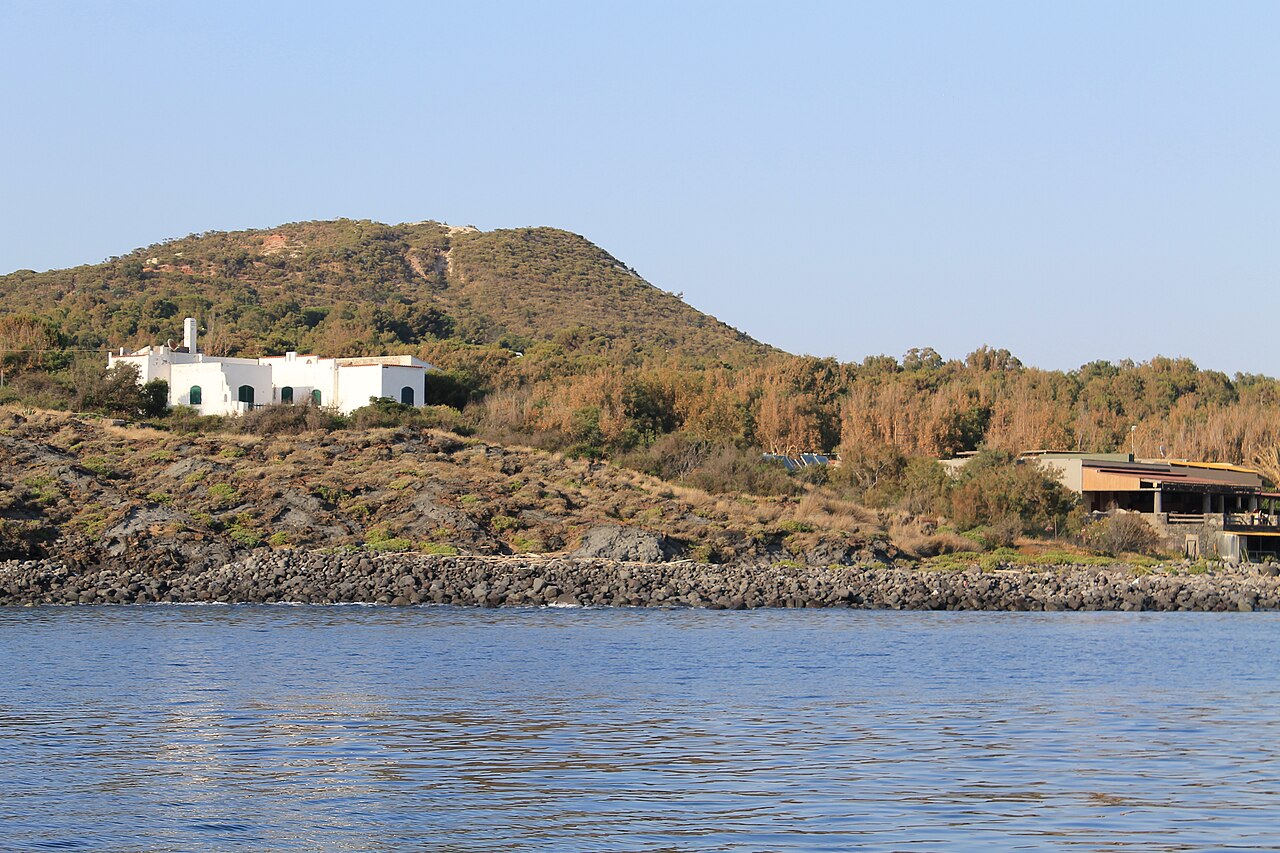
Porto di Ponente is a sheltered natural bay guarded at its seaward entrance by the Scoglio delle Sirene. The bay is enclosed by the narrow sandy isthmus that connects Vulcano to Vulcanello, a fragile natural bridge that winter seas occasionally submerge when heavy storms sweep through the channel. This sandy strip encloses one of only two coastal lagoons found anywhere in the Aeolian archipelago, the other situated at Punta Lingua on Salina.
Course
Part of the Italian Open Water Tour circuit. The course takes place in the protected marine area of Vulcano, featuring natural buoys including a sea stack and the volcanic landscape.
Part of the Italian Open Water Tour circuit. The course takes place in the protected marine area of Vulcano, featuring natural buoys including a sea stack and the volcanic landscape.
Part of the Italian Open Water Tour circuit. The course takes place in the protected marine area of Vulcano, featuring natural buoys including a sea stack and the volcanic landscape.
Part of the Italian Open Water Tour circuit. The course takes place in the protected marine area of Vulcano, featuring natural buoys including a sea stack and the volcanic landscape.
Previous editions
- 2025results
How to get there
Vulcano, Messina. Accessible by sea via connections to the Aeolian archipelago.
IOWT Traversata delle Eolie — Vulcano
Frequently asked questions
- When was the last edition of IOWT Traversata delle Eolie — Vulcano?
- The last edition of IOWT Traversata delle Eolie — Vulcano took place on October 17, 2026.
- What distances does IOWT Traversata delle Eolie — Vulcano offer?
- IOWT Traversata delle Eolie — Vulcano offers 500 m, 926 m, 1.9 km, 3 km, and 6 km.
- How much is the entry fee for IOWT Traversata delle Eolie — Vulcano?
- The entry fee ranges from 20 € to 55 €.
- Where does IOWT Traversata delle Eolie — Vulcano take place?
- IOWT Traversata delle Eolie — Vulcano is a sea swim. Location: Vulcano, Sicilia, Italy.
- How do I register for IOWT Traversata delle Eolie — Vulcano?
- The reference page for registering for IOWT Traversata delle Eolie — Vulcano is https://italianopenwatertour.com/vulcano/.
Where to stay
Accommodations in Vulcano are primarily composed of family-run boutique hotels and traditional Mediterranean-style villas, with several camping areas located near the black sand beaches. Due to the limited size of the island, supply is tight during race weekend; expect to pay between €120 and €250 per night for high-quality harbor-view rooms. It is advisable to book at least four months in advance to secure a spot within walking distance of the start line.
Things to do nearby
Beyond the race, the island is defined by its volcanic nature. Visitors typically engage in guided trekking to the crater rim to view the active fumaroles, or rent kayaks to explore the sea caves along the coastline. The area is also known for local wine tastings, specifically the Malvasia delle Lipari, which pairs with the island’s maritime history. For those interested in antiquity, the acropolis in nearby Lipari hosts archaeological sites that document the island's long-standing connection to the god Aeolus.
Swimmers
Other stages of this series
- Genova – Italian Open Water Tour 2026Genova, IT
- Tremiti – Italian Open Water Tour 2026Isole Tremiti, IT
- Monate – Italian Open Water Tour 2026Travedona Monate, IT
- Gaeta – Italian Open Water Tour 2026Gaeta, IT
- Leggiuno – Italian Open Water Tour 2026Leggiuno, IT
- Camogli – Italian Open Water Tour 2026Camogli, IT
Similar races


Comments
Transparency: some links on this page (stays, flights, experiences, gear) are affiliate links — if you book or buy through them, Omniathlon may earn a commission from the partner at no extra cost to you. As an Amazon Associate we earn from qualifying purchases.