
Australia Day Newcastle Harbour Swim
- Jan 26, 2026
- Last edition date
- Distances: 700m and 1.4km
At a glance
- Last edition date
- January 26, 2026
- Distances
- 700 m · 1.4 km
- Where
- Sea · Newcastle Harbour, Stockton, New South Wales, Australia
- Wetsuit
- Wetsuits are allowed but not required; water temperatures typically 22–24°C (72-75 °F).
About the race
Long before swim caps and marker buoys lined the channel, Stockton locals who missed the final evening ferry from Newcastle had only one way home: diving straight into the dark waters of the harbour to swim the 700-metre crossing. That impromptu midnight commute inspired the Australia Day Newcastle Harbour Swim, an open water swimming event held in the protected sea channel of Newcastle Harbour at Stockton, New South Wales. Every late January, this historic rite of passage turns into a celebrated public gathering organized by the Stockton Surf Life Saving Club as its major annual fundraiser. Stepping into the harbour where generations once swam home, you dive into an iconic maritime corridor pulsing with local community history.

Entering the water reveals an unmistakable urban arena where swimmers stroke across a bustling working harbour, gliding alongside stationed tugboats and passing ferries while crowds cheer from both waterfront shores. Swimmers choose between two straightforward routes across the channel. The 700-metre course runs an out-and-back line from Stockton Wharf out to a mid-channel marker and returns to the beach, open to competitors aged twelve and above. Swimmers seeking the complete crossing take on the 1.4-kilometre double loop, departing from the Stockton side, touching Queens Wharf across the water, and swimming all the way back, welcoming anyone aged fourteen and over. Despite Newcastle Harbour operating as a major commercial shipping lane, the race conditions are remarkably well protected.
Swimmers encounter limited ocean swell and largely flat water, though shifting coastal breezes and changing tides can kick up light surface chop. During the late-January summer, the water remains comfortable and mild, creating ideal conditions for traditional skins swimming, though wetsuits are also permitted. The event holds serious athletic pedigree alongside its grassroots charm, with past winners of the 1.4-kilometre race including Australian Olympic swimmers Justin Norris and Thomas Fraser-Holmes.
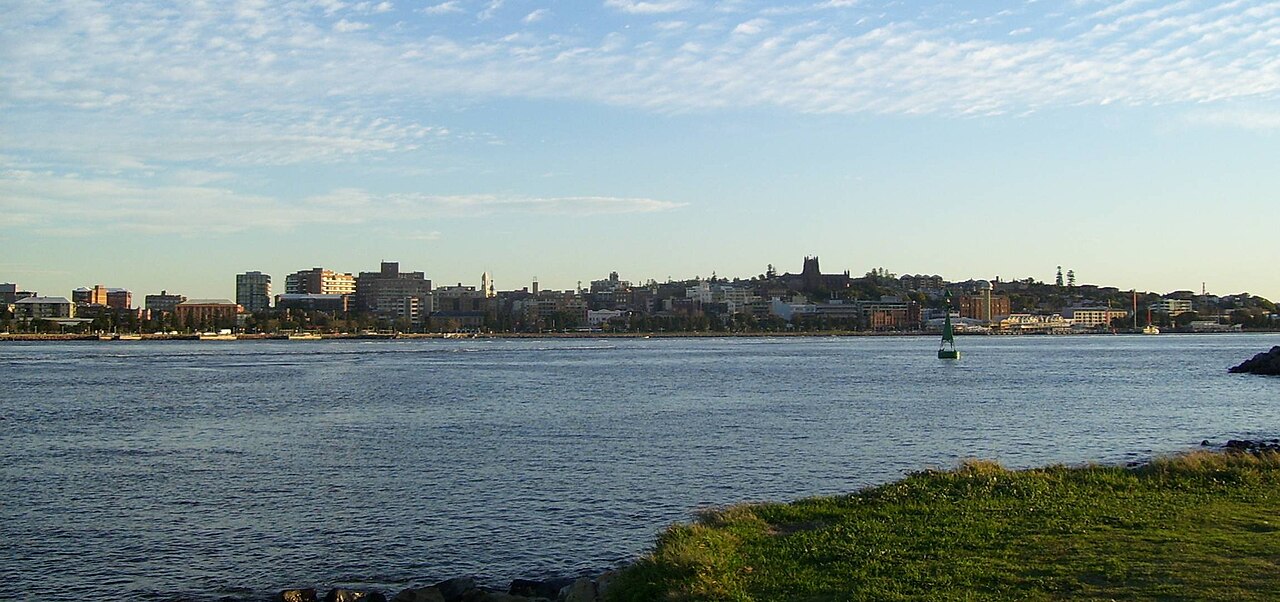
The Hunter River and Kooragang Wetlands at Newcastle
The waters filling the harbour race basin journey across hundreds of kilometres of New South Wales country before meeting the open ocean. The Hunter River originates high in the Liverpool Range inside Barrington Tops National Park, descending 1,397 metres over its 468-kilometre journey before discharging into the Tasman Sea at Newcastle. The Kooragang Wetlands form an internationally recognized Ramsar-protected sanctuary, splitting the powerful river flow into two main estuarine arms. Centuries before industrial shipping transformed the estuary, the Wonnarua Aboriginal people knew the river as Coquun, meaning fresh water. Fishermen exploring the waterway in June 1796 encountered rich mineral seams, prompting them to briefly dub the passage the Coal River. That discovery altered the destiny of the basin forever. Today, Newcastle Harbour ranks as the world's largest coal export port, yet on race morning the bustling industrial docks yield the central fairway to colourful swimming caps and roaring spectator crowds.
Nobbys Head and the breakwall of Newcastle Harbour
Guarding the seaward entrance to the harbour just one kilometre from the swim course stands Nobbys Head, a dramatic landmark with an altered past. Originally an isolated island rising over 60 metres out of the sea, the rocky outcrop was joined to the southern mainland in 1846 by a stone causeway. Engineers subsequently reduced the island's height to improve wind flow for sailing vessels entering the passage and to create a level platform for the historic lighthouse and signal station established in 1858. Guiding mariners through the treacherous entrance required constant technical reinvention. The harbour's earliest navigational marker burned as an open coal fire atop Signal Head, casting its light seven kilometres into the night.
A metal oil apparatus extended the beacon's range to twelve kilometres in 1821, though unreliability forced keepers temporarily back to burning coal. The lighthouse underwent electrification and automation in 1934, and today a 1,000-watt quartz halogen lamp, supported by backup diesel generators, keeps watch over the channel mouth. In the lee of the nineteenth-century breakwall, the golden sands of Nobbys Beach took shape, providing shelter for beachgoers and harbour vessels alike.
Stockton Breakwall and the shipwrecks of Oyster Bank
In July 1866, the paddle-steamer SS Cawarra sank bow-first in the harbour mouth while desperately attempting to escape rough ocean conditions outside. Two kilometres from the swim site lies the Stockton breakwall. In September 1904, violent seas swept the four-masted steel barque Adolphe onto the wreck of the Colonist and firmly aground upon the bank. Instead of clearing the stranded vessel, workers removed the Adolphe's masts and jib-boom in 1906. Where it came to rest, the hull sits directly atop the older broken remains of the SS Wendouree from 1898 and the SS Lindus from 1899. Shipwreck lore touches the inner river channel as well: less than a kilometre from the race area, the passenger ferry Bluebell sank in August 1934 after a collision with the freighter Waraneen, before being broken apart by passing steamer screws and having its rudder salvaged by fishermen decades later.
Bogey Hole and Newcastle Ocean Baths along the coast
Two kilometres along the rocky coastal rim, Newcastle holds an extraordinary swimming tradition carved straight into the living sandstone. The Bogey Hole is a saltwater bath hand-hewn by convict labour around 1820 on orders from Lieutenant-Colonel James Thomas Morisset at the foot of Shepherds Hill. Quarried out of classic Hawkesbury Sandstone, the pool was expanded in 1884 to seven times its original volume, creating a protected ten-metre pool where waves cascade over the rocky edge and where Greek Orthodox congregations have celebrated the Blessing of the Waters since the 1950s. Equally beloved by local ocean swimmers is the grand complex of the Newcastle Ocean Baths, whose construction commenced in 1910.
Swimmers were already plunging into its seawater enclosure and the adjacent Canoe Pool well before the outbreak of World War I. The formal public opening arrived in the 1920s, accompanied by the building of an ornate coastal pavilion that began construction in 1922. Floating in the calm harbour water between Stockton and Queens Wharf, you share a channel shaped by working boats and generations of swimmers who claimed these tidal waters as their own.
Sources: Hunter River (New South Wales) · Pasha Bulker · Newcastle Ocean Baths · TSS Maianbar · Active (1877)
Course
Out-and-back course starting from Stockton Wharf to a halfway marker and returning to the start.
Double crossing of the harbour. Starts at Stockton, swims to Queens Wharf, rounds a turn buoy, and returns to Stockton.
Awards
The 700m event is described as non-competitive with no prizes or prize money.
How to get there
Australia Day Newcastle Harbour Swim
Frequently asked questions
- When was the last edition of Australia Day Newcastle Harbour Swim?
- The last edition of Australia Day Newcastle Harbour Swim took place on January 26, 2026.
- What distances does Australia Day Newcastle Harbour Swim offer?
- Australia Day Newcastle Harbour Swim offers 700 m and 1.4 km.
- Is a wetsuit required at Australia Day Newcastle Harbour Swim?
- Wetsuits are allowed but not required; water temperatures typically 22–24°C (72-75 °F).
- Where does Australia Day Newcastle Harbour Swim take place?
- Australia Day Newcastle Harbour Swim is a sea swim. Location: Newcastle Harbour, Stockton, New South Wales, Australia.
Where to stay
Stockton offers a quieter, residential atmosphere compared to the main city center, with a mix of beachside holiday apartments and low-rise motels. Most options are within walking distance of the Stockton Ferry and the race start area. Prices typically range from $150 to $300 per night during the summer peak, with larger holiday rentals available for families or groups.
Things to do nearby
The area is ideal for exploring the maritime history of the Hunter region. Post-swim, visitors often head to the Newcastle foreshore for local seafood, or take the short ferry ride across to the city's cafes and museums. Kayaking and SUP rentals are popular along the calmer stretches of the harbour, providing a different perspective of the port's industrial scale.
Swimmers
Similar races


Comments
Transparency: some links on this page (stays, flights, experiences, gear) are affiliate links — if you book or buy through them, Omniathlon may earn a commission from the partner at no extra cost to you. As an Amazon Associate we earn from qualifying purchases.