
Rheinschwimmen
- May 14, 2026
- Last edition date
At a glance
- Last edition date
- May 14, 2026
- Where
- River · Rhein, Köln, Nordrhein-Westfalen, Germany
- Entry fee
- 25 €
- Wetsuit
- Wetsuits, fins, or costumes are allowed.
- Registration
- duc.koeln
About the race
The Kölner DUC-Rheinschwimmen is an open water river swim organized by DUC Köln down the waters of the Rhine in Cologne, North Rhine-Westphalia. It offers swimmers an extraordinary opportunity to navigate right through the heart of the urban river corridor. The event welcomes DUC club members alongside their families and friends from affiliated swimming and diving clubs. Entering the river later in the morning, participants plunge into the flow for a five-kilometer downstream journey. Carried by the steady river drift, the pack sweeps beneath four prominent bridges while watching the iconic Cologne Cathedral rise over the city waterfront. Thanks to the relentless downstream push of the channel, the entire five-kilometer stretch takes only about one hour to complete.
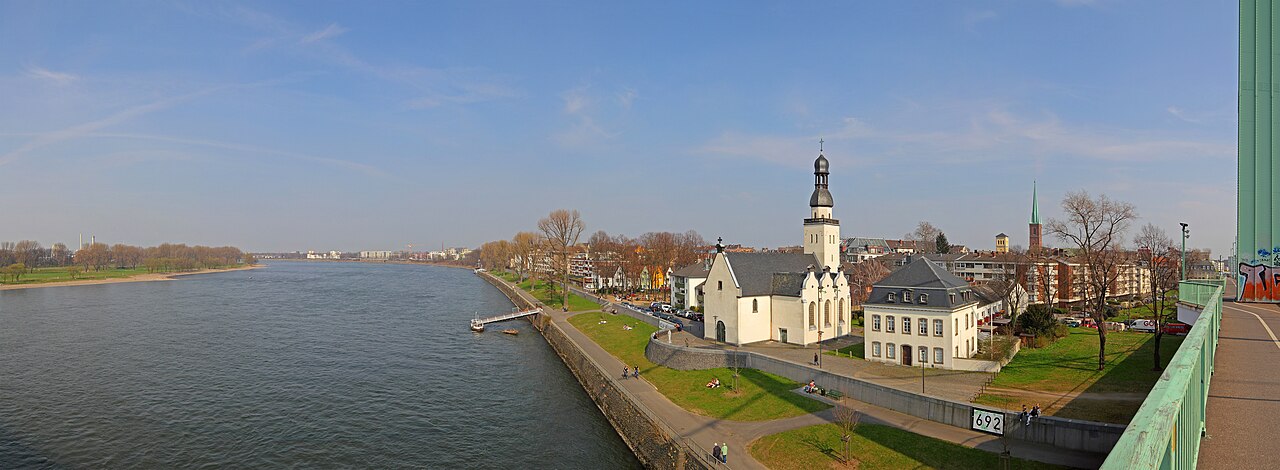
The mood on the water resembles an open-air carnival, with many participants donning imaginative and colorful costumes over their wetsuits. Neoprene and fins are permitted, with past participants swimming dressed as swans or hauling drifting branches as personal trophies. While fins are allowed to assist navigation in the moving water, air mattresses and inflatable loungers are strictly forbidden to ensure the safety of the field. Even with the cheerful costumes and festive atmosphere, maintaining rhythm across moving river eddies can prove physically demanding and occasionally induce leg cramps. The buoyant support of wetsuits and the brisk one-hour duration help swimmers manage the physical effort together as they drift with the flow. To maintain clear heads in the river current, alcohol is strictly banned while in the water, reserving celebratory glasses of beer for the post-swim festivities on shore.
The Rhine's powerful flow: currents, extremes, and returning life
Over the centuries, the river has seen astounding hydrological extremes. During an intense dry spell in October 2018, the Rhine in Cologne dropped to an all-time recorded low of just 0.67 meters.
Constantine's crossing: the Roman bridge and naval fort of Alteburg
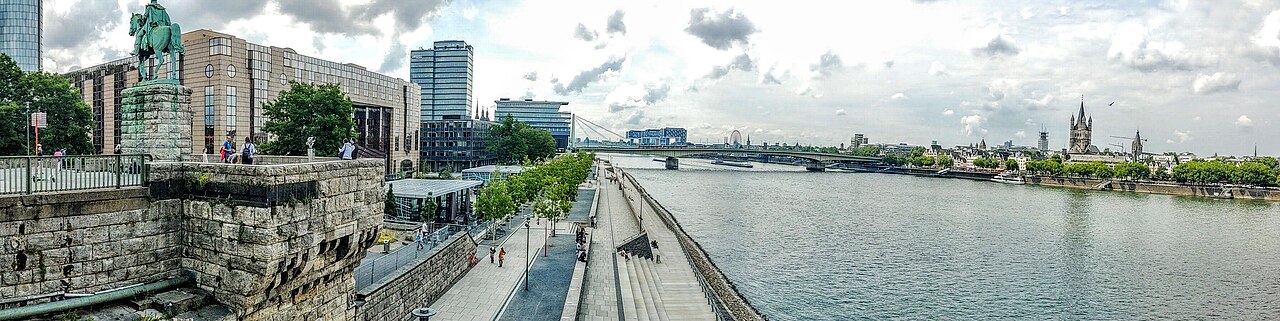
Long before modern swimmers entered these waters, the Germanic Ubii established their settlement on a natural rise along the Rhine protected from regular seasonal floods, establishing what became Colonia Claudia Ara Agrippinensium. To defend this vital waterway, the Roman imperial fleet was stationed at the Alteburg naval fort, situated three and a half kilometers south of the ancient settlement. This strategic garrison anchored the river frontier until it was destroyed during Frankish assaults in 276 AD. To bridge the powerful river gap, Emperor Constantine I ordered the construction of a permanent Roman bridge in 310 AD, creating the very first fixed bridge across the Rhine in this region. Erected by the legionaries of Legio XXII Primigenia, the strategic river crossing was guarded on the opposing right bank by the castellum of Divitia.
Building a permanent bridge over such a formidable current was a landmark feat of Roman civil engineering. Engineers drove massive oak piles deep into the riverbed, packing the foundation gaps with mortar and crushed stone to support nineteen heavy stone piers. These stone pillars carried an expansive wooden truss deck that stretched over 400 meters in length and roughly 11 meters in width, spanning the very riverway traversed by the swim.
The Roman island of Groß St. Martin and waterfront villas
Groß St. Martin originally stood on a natural Rhine island positioned east of the Roman Praetorium. Archaeological excavations under the church revealed a massive first-century water basin measuring 34 by 17.2 meters, thought to have functioned as an ancient swimming pool or a holding tank for fresh fish and shellfish. During the second century, four large halls were erected directly against the riverbank to serve as commercial warehouses for trade goods arriving by boat. This same riverside hosted high-status domestic life, including a Roman peristyle villa positioned in close proximity to the water's edge. The elegant residence opened onto an enclosed central courtyard garden featuring an ornamental fountain. This luxurious waterfront dwelling was ultimately destroyed by fire during a Frankish raid on the city in December 355 AD.
Stapelhaus and the medieval trading laws along the Rhine
Throughout the Middle Ages, the Rhine remained an unpredictable river highway, carrying Viking longships upstream during the winter raid of 881 to torch riverside sanctuaries like St. Maria im Kapitol. In later centuries, the current served as a vital cultural route, transporting masterfully carved sandstone sculptures by Niclaus Gerhaerts into the city. Commercial life centered around the riverside fish market and the historic Stapelhaus. Under the Stapelrecht law enacted in 1259, all commercial vessels travelling the Rhine were legally obliged to dock in Cologne and display their cargo for local sale. The Stapelhaus structure, rebuilt in the sixteenth century with a half-timbered facade facing the water, formed an integral part of the stone city wall along the bank.
In those early centuries, commercial waste pipes from the fish market drained directly into the passing river. The restrictive mandatory transshipment laws were eventually struck down by the Congress of Vienna in 1815 and abolished altogether by 1831. Lovers continue the romantic custom of securing padlocks to the Hohenzollern Bridge railings before casting the keys down into the riverbed.
Sources: Köln · Colonia Claudia Ara Agrippinensium
Course
The swim takes place in the Rhine river, starting from Poller Rheinwiesen and ending at Rheinpark. The route passes under four bridges, the 'Siebengebirge', the Kranhäuser buildings, and the old town panorama.
Awards
This is a social event, not a competitive race.
How to get there
Rheinschwimmen
Frequently asked questions
- When was the last edition of Rheinschwimmen?
- The last edition of Rheinschwimmen took place on May 14, 2026.
- How much is the entry fee for Rheinschwimmen?
- The entry fee is 25 €. Includes free parking in the reserved area.
- Is a wetsuit required at Rheinschwimmen?
- Wetsuits, fins, or costumes are allowed.
- Where does Rheinschwimmen take place?
- Rheinschwimmen is a river swim. Location: Rhein, Köln, Nordrhein-Westfalen, Germany.
- How do I register for Rheinschwimmen?
- The reference page for registering for Rheinschwimmen is https://duc.koeln/2026/04/01/rheinschwimmen-2026/.
Where to stay
Cologne offers a diverse range of stays, from modern hotels near the central train station and the cathedral to traditional guesthouses in the historic Old Town. Visitors often opt for boutique hotels along the riverfront or functional apartments in the Deutz district, which provides easy access to the Rheinpark start area. Expect to pay between 120 EUR and 220 EUR per night for a mid-range double room, depending on the proximity to the city center and the event date.
Things to do nearby
Beyond the water, the city is defined by its deep Roman history and ecclesiastical landmarks. You can explore the Roman-Germanic Museum or take a walking tour of the Old Town, where alleys like Lintgasse still bear the names of medieval trades. For active recovery, the city offers extensive cycling paths along the Rhine or guided kayak tours. In the evenings, the local breweries in the Altstadt are essential for experiencing the regional Kölsch culture, which remains a central pillar of Cologne's social life.
Swimmers
Similar races


Comments
Transparency: some links on this page (stays, flights, experiences, gear) are affiliate links — if you book or buy through them, Omniathlon may earn a commission from the partner at no extra cost to you. As an Amazon Associate we earn from qualifying purchases.