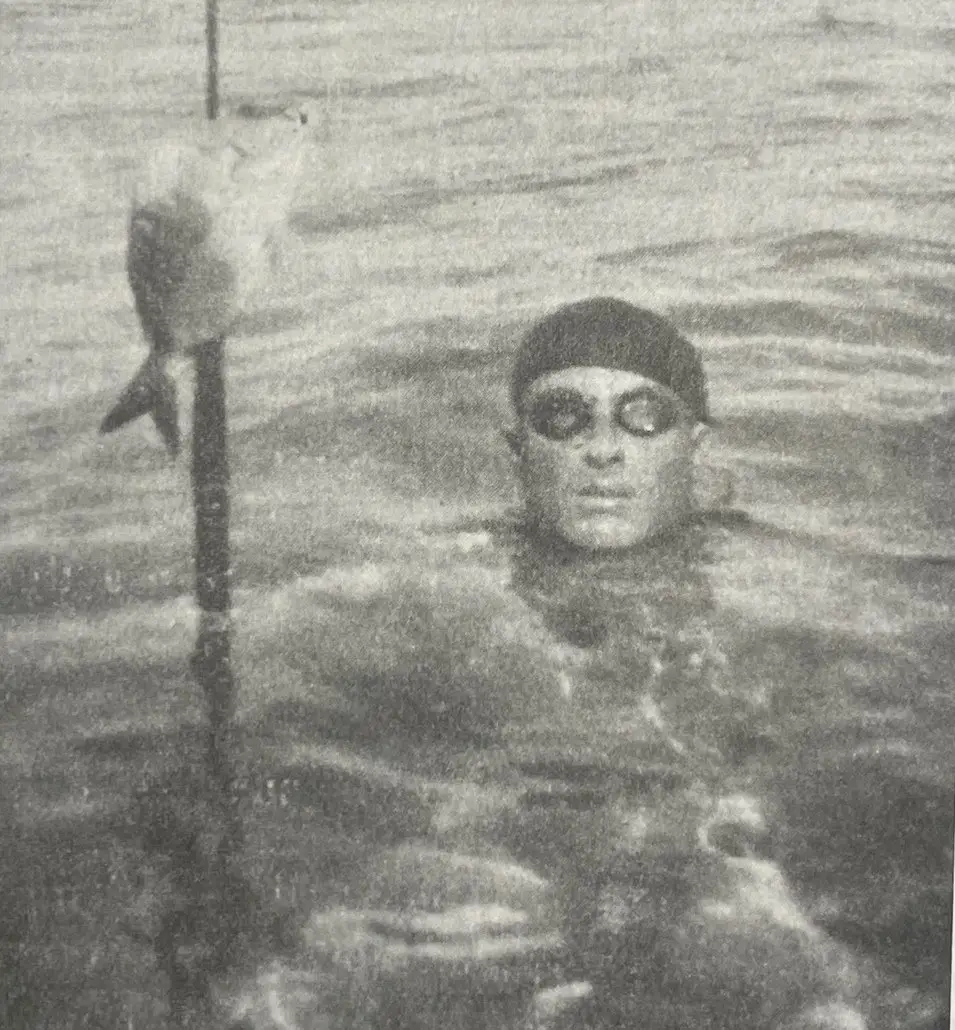
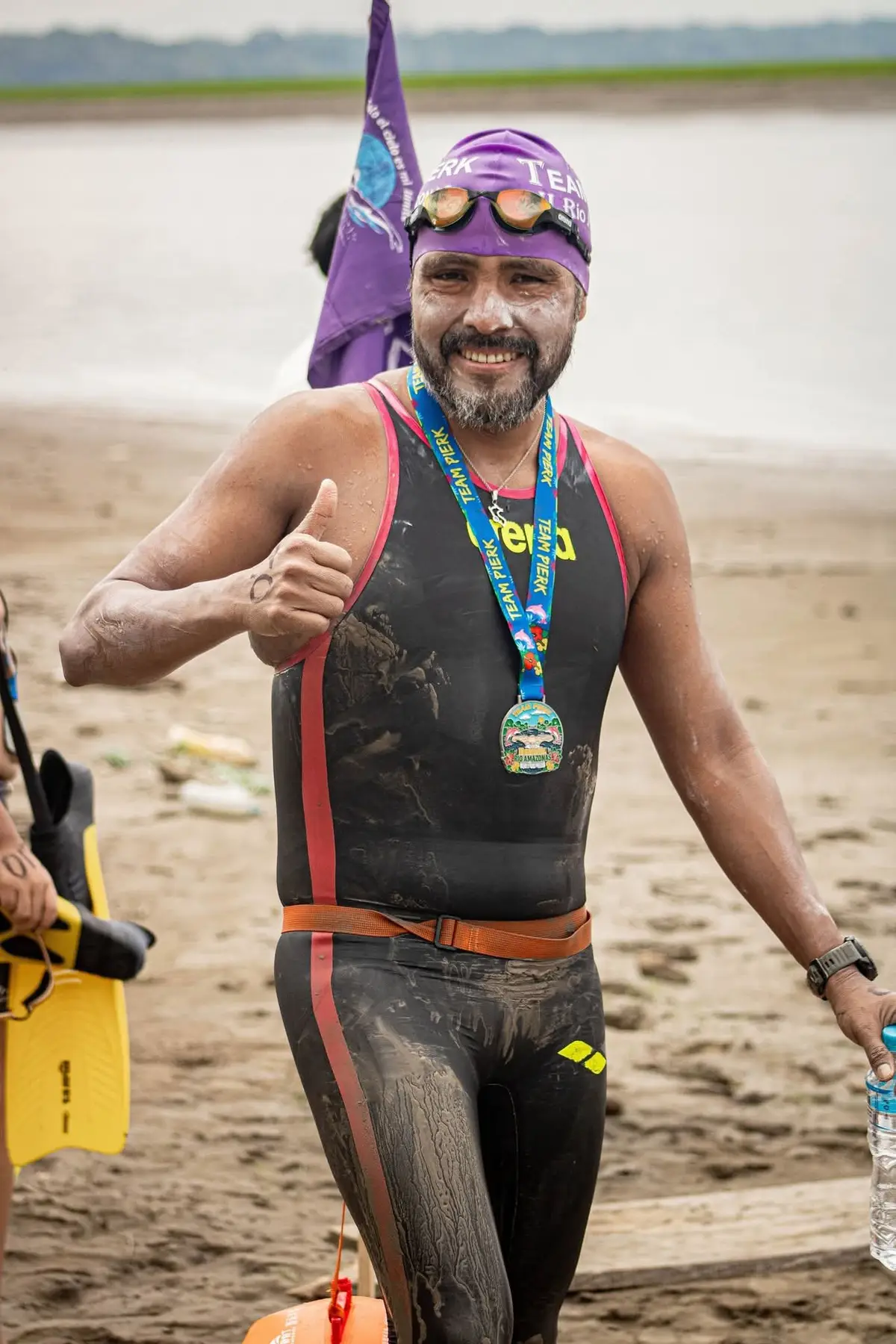
Some open water swimmers' stories are so incredible that I can't help being intrigued. The ones I like telling most are about "ordinary" swimmers doing things that are far from ordinary. On 23 August 2026, Carlos Rolando Gutiérrez arrives in Iquitos (Peru) with skin caked in mud and a few splinters in his hand from a collision with a floating log. He has just swum 50 km down the Amazon at the Travesía Internacional Amazónica, in six and a half hours.
The story would already be interesting as it is, but what blew my mind is that, out of the water, Carlos is a civil engineer working in the mining industry, in the Andes, between Ancash and Huánuco, at 4,200 metres. His life is split between eight days at the mine, working twelve-hour shifts, and six days off in Lima, at sea level. Extreme swimming is born in that barometric fracture.
Rationed oxygen
Climbing to 4,200 metres and then coming back down to sea level every shift is a jolt the body feels, and one Carlos manages with the same care he brings to planning a construction site.
His training load builds gradually over the first days at the mine and eases on the seventh and eighth day, when fatigue is already felt. "The body is sensitive to those altitude changes, both going up and coming down."
Sleep is the first thing to give. "The lack of oxygen shows up as broken sleep in the first days; from day 4 on we're already more adapted." At the mine he sleeps six and a half hours on average; in Lima, more than eight. Dinner at the mine is at 5:30 in the afternoon, so as not to go to bed with digestion still under way.
The sea lost and found
Carlos's father, a swimming teacher, teaches him the strokes at the age of nine; Carlos swims, but doesn't compete. His father instils in him a reverent respect for the ocean and forbids him from going too far from shore. Then studies, university and work keep Carlos away from the water for decades.
At thirty-six, a triathlete friend takes him to the beach on a 22 December. Carlos goes in wearing a surfer's wetsuit and borrowed goggles and cap. He swims only 350 metres and comes out exhausted, but thrilled.
Logistics between 0 and 4,200 m a.s.l.
A commuter's logistics impose fierce trade-offs. At the mine there are no pools. Carlos runs, lifts weights, stretches and does mobility work: the land training a swimmer needs for joints and core. He alternates swimming with running (several half marathons and one marathon, in Chile).
When he comes down to Lima, water becomes his obsession. To put behind him the kilometres his sporting ambitions require, he trains with double sessions, in the pool and in the sea (ten minutes on foot from home). The training volume forces him to spend a lot of time alone.
"For now I train alone because the loads I handle are very high and I need concentration."
"Along this road I've been travelling for 10 years, every time I improved my performance further I had to move away from the groups, because they don't have the same goals I'm chasing, so the training process ends up being a solitary road almost always."
The Amazon
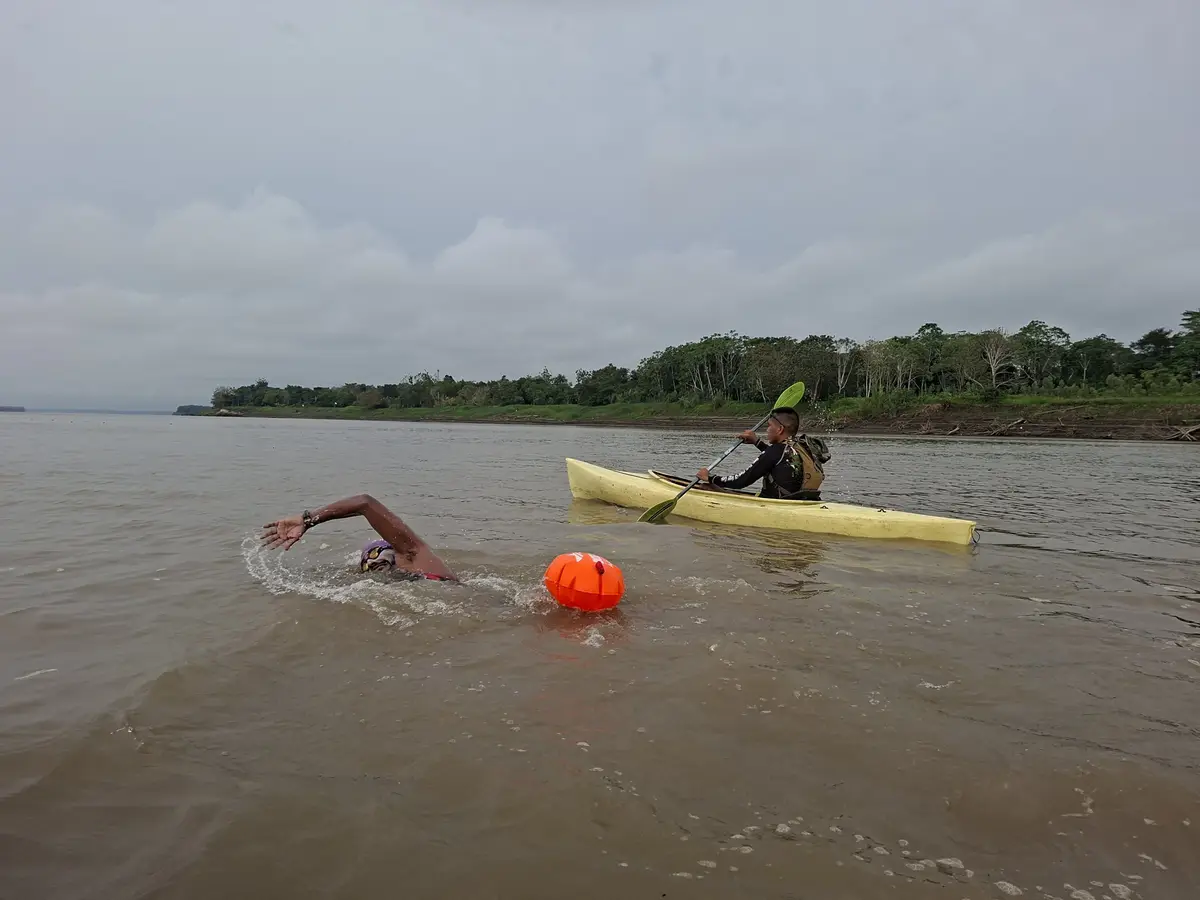
The Amazon is no ordinary racecourse. It is, quite simply, the river par excellence. It is the biggest in the world, if not by length (6,992 km, a record disputed by the Nile), then certainly by flow (175,000 m³/s on average). "The brown water is very dense, the temperature is 28°C, really warm, the current pushes you at 7 km/h but you have to know where to swim, because there are sandbank areas (beaches) where you lose that push." Once you are in it, visibility is zero: "You can't see anything, you can't see your arm or your hand under the water."
Who organises the race
The organiser is Nervith Angulo, a local swimmer who, with Team Pierk, organises running and swimming events in the city of Iquitos. In 2025 the organisation laid out a 25-kilometre course starting from Aucayo. The swimmers who had done it asked to push the limit further. In 2026 the distance doubled, turning the event into what Carlos bluntly calls "a milestone in open water swimming in PERU", and I would add "and of the world". This year only 16 were at the start, 3 of them foreigners.
The memory of the water
Carlos didn't come to the Amazon blind. In 10 years he has raced in the Azul, Pacucha and Paca lagoons, in the immense Lake Titicaca, in the Uzuña reservoir, in the seas of Arequipa, Piura, Tumbes and Ancash of his beloved Peru. Abroad he has swum in Ecuador and Colombia (twice in each), and in Brazil, Argentina, Thailand and Dubai. His river apprenticeship runs through the 6 kilometres swum in the Huallaga in 2024, in the high jungle, through the 21 kilometres of the Paraná and, above all, through the 25-kilometre edition on the Amazon in 2025.
Fifty kilometres of current, peque-peque and mud
The transfer to Tamshiyacu starts at four in the afternoon the day before. Two hours' journey, arriving after dark, the technical briefing, dinner and bed. At 6:12 in the morning they enter the water.
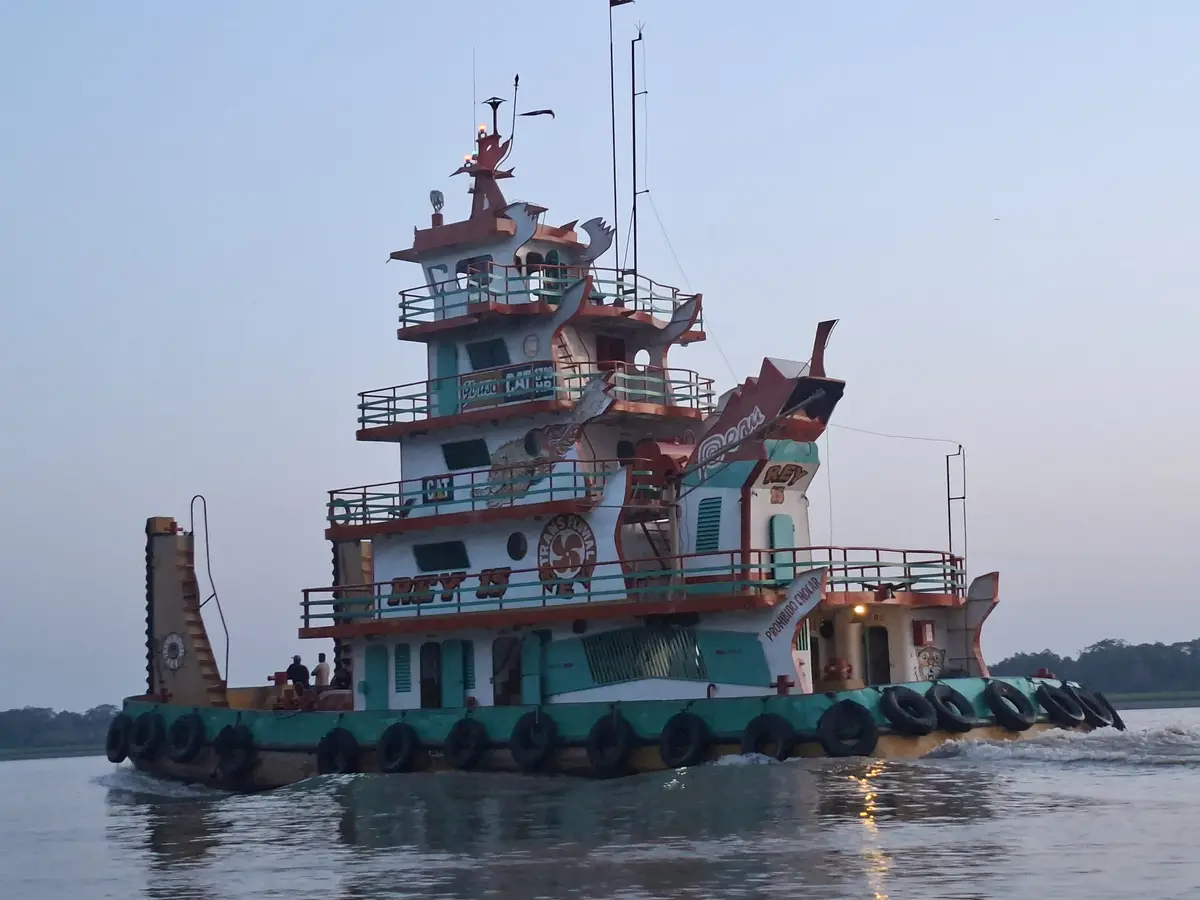
Every swimmer is accompanied by a peque-peque, the local name for the motorboats. On Carlos's boat is also his wife who, besides putting up with and supporting Carlos in his training and travel throughout the year, takes care of logistics and his feeds. Every thirty minutes she hands him 40 grams of carbohydrate gel, 450 millilitres of water and a mineral salt tablet (if you want a hand preparing a fuelling plan for a race, have a look at this tool).
Carlos is also accompanied by a kayaker, Victor Chavez, a police officer with water-rescue experience, the same one who had accompanied him in 2025 on the 25 km. Victor's job is to keep Carlos on the lines of strongest current, steer him away before an impact with floating logs, and trace the way into the entrance to Iquitos, which can prove "laborious". In August the river is low, hence: "I had to stick close to an islet that had been left exposed after the river dropped, and on that side I had to swim almost in the mud, it was very hard." Carlos stands there, muddy, with a few wood splinters in his hand, but with a broad smile: after 6 and a half hours he has crossed the finish line of the 50 km on the Amazon.
The map traced
I asked Carlos how open water swimming is doing in Peru. Peruvian geography offers a fascinating catalogue: the cold seas of the south at 18 °C, the warm ones of the north at 24 °C, Andean lagoons at 3,200 metres, Titicaca at 3,800 metres, and the rivers of the jungle. What is missing is infrastructure: Olympic pools, sports centres with gyms.
In Lima pools are few and swimming ends up being a sport for well-off social classes: pool fees, goggles and wetsuits cost money. It is the same mechanism we describe in Drowning in Inequality: knowing how to swim as an indicator of class.
On top of this comes the enormous weight of local beliefs. In front of Lake Pacucha, in Andahuaylas, some inhabitants superstitiously believe the water swallows men, and live their whole lives facing the lake without learning to swim. Before the race on the Amazon many people talked about anacondas and piranhas. They live in the river, but flee from the noise of boat engines and humans are not part of their diet. The only problem Carlos met was floating logs: you have to avoid them carefully. During the 25 km, the year before, he had seen the pink dolphins; in 2026 only his wife saw them, from the peque-peque.
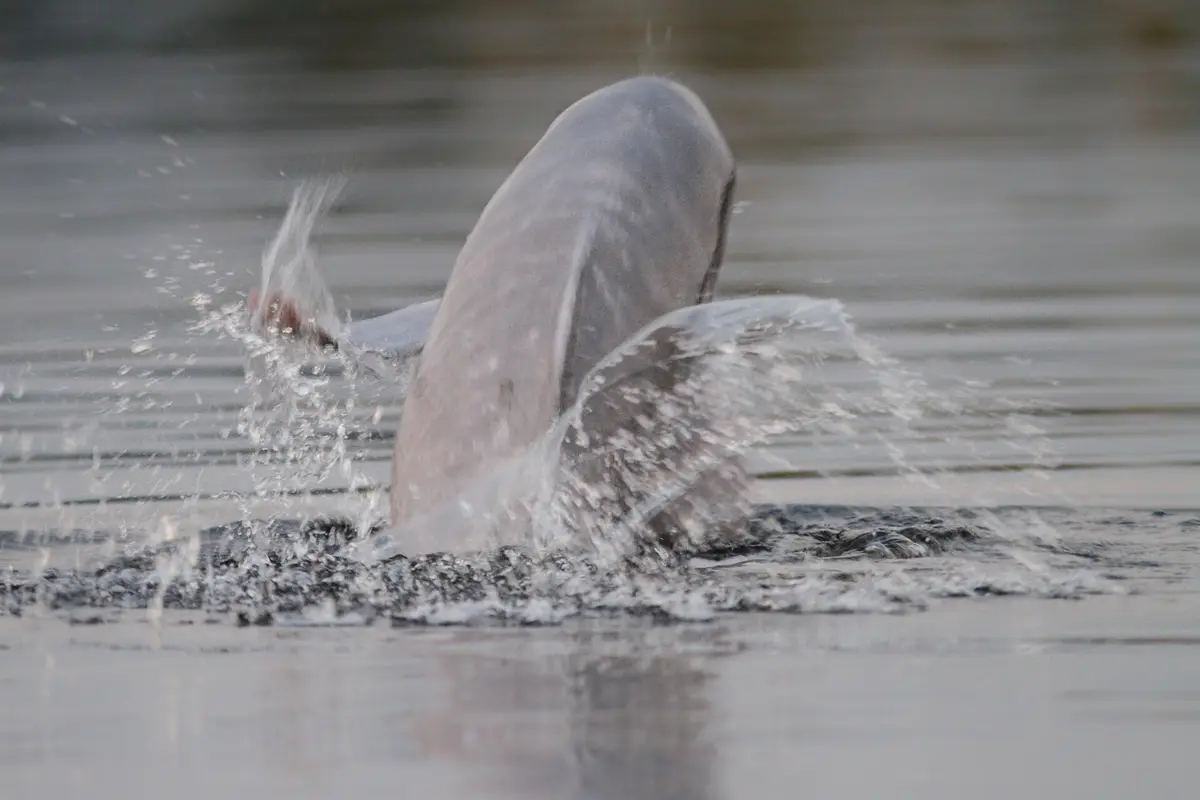
Often the organisations too are still at an early stage. According to Carlos, in some cases races lack buoys, the start time slips, results arrive late, and escort boats hired from locals fail to deliver.
The gap with another South American country such as Argentina is also in the numbers. On the Paraná, in December 2025, there were 99 at the start. In Argentina, the 54-kilometre Santa Fe–Coronda marathon sells out in a few days. At the 50 kilometres of the Amazon, there were 16. A handful of brave souls, like the nineteen at the start of the Toroneos Gulf, 26 kilometres of silence swum since 1971: except that there is half a century of history behind it, while here it is the beginning.
Despite these difficulties, Peruvian swimming is growing and, according to Carlos, "the Peruvian races that foreigners should swim, I'd say there are three: Amazonas 50k, Reto Titicaca 7k and Ruta Olaya 22k."
If you want to meet Carlos: next year he will swim around Manhattan, 46 km, and he is already signed up for the Strait of Gibraltar crossing, from Spain to Morocco: he is waiting for the schedule, maybe in 2028, because there is a lot of demand from swimmers.