
There is a photograph, taken on July 4, 2025, at the finish line in Amposta, that is worth a small piece of open water swimming history: a twenty-one-year-old Malaysian girl, Chelsea Ning Lee, with a crown on her head and a trophy in her hands. In the photo, she has just won the women's event at the UltraEbre, thirty-one kilometers of river, and with that final stroke, she completed a journey that began two years earlier on the Charente and passed through the Thames, leading her to become the first person in the world to complete the Marathon River Swim Series and earn the title of the first Marathon River Queen.

To understand what lies within that steel crown (and why only a handful of people have conquered it in four seasons), you have to look at the three rivers that award it. Because the Marathon River Swim Series is not just a challenge of kilometers, but also of diversity.

The rules
A challenge born in the water
The challenge began in 2022, and it is from that date that the regulations count valid finishes. The idea is simple: complete three river marathons (all very different from one another), in any order, within five years. Those who succeed are crowned Marathon River King or Queen. Each completed race earns a fabric badge, and the trio earns a limited-edition commemorative prize. The true value, as is often the case, lies not so much in the title as in the experience. The public register of aspirants—anyone who has finished at least one of the events—now exceeds sixteen hundred names.

- The fabric badge for each completed race. © Marathon River Swim Series
The original trio spoke French, Spanish, and English, including races in the Charente, Ebro, and Thames rivers. Then the circuit experienced its own small sporting drama, and since 2025, the Norwegian GlommaDyppen has replaced the Thames Marathon, shifting the challenge's center of gravity northward toward colder and less predictable waters. In the meantime, the circuit has gained momentum, and as of February 2025, the series entered the top ten of the World Open Water Swimming Awards as "Best Event".
What makes conquering the crown so difficult is not just the kilometers, but the diversity of the races: three rivers that pose three different challenges, none of which can be overcome using the strengths required for the other two.
The first river
EbroThe river that changes its mind
The UltraEbre Swim Marathon is the dean of the group and has been swum since 2012 between Tivenys and Amposta, along a course that winds for thirty-one kilometers through the final stretch of the Ebro in Catalonia. The series presents it as "the longest and toughest point-to-point swim in Southern Europe," but the way in which it is tough is peculiar and almost subtle.
The first sectors are a pleasure for swimmers. The current pushes, and in the good initial stretches, top speeds near 10 km/h are reached. The July water, usually around 26 degrees, makes everything "easy," until the river changes its mind. Ruffo Paolini, an Italian-Belgian veteran of the event, describes it this way in the interview published by the organizers: "The first 20 kilometers can seem almost easy. You think: I'm flying, I've got this. That is the trap."

In fact, after passing Campredó, the river changes character. As it approaches the delta, the flow slows down, and in the early afternoon, just when the slower swimmers reach these sectors, a sea breeze rises, blowing against the swimmers, rippling the surface, and slowing them down. On the worst days, the tidal effect can even reverse the push, and you might find yourself swimming against the current. Thus, it happens that your pace collapses at the exact moment when fatigue is at its peak. "The last 10 kilometers are the real race," Paolini adds. Elena Edatti, another voice in "The Experience" project, summarizes the same idea from the opposite perspective: "The current helps you for part of the swim, then it tests you toward the end. You have to respect the river, listen to your body, and manage your energy carefully." (her interview here)
The race numbers tell the rest: each swimmer has their own kayaker by their side, the gate at the Tortosa rowing club closes at 5 hours, and the maximum time to finish the event is 8 hours. The records (4h21'38" by David Alcolado and 4h52'44" by Bárbara Viazzo, both from 2020) show that when the Ebro cooperates, it is a very fast race. When it doesn't, however, the race becomes a test of inner patience.


The second river
CharenteThe interrupted marathon
Le Flow des Gabarriers is deeply different from the Ebro. Thirty-three kilometers long from Châteauneuf-sur-Charente to Cognac, it winds between castles and vineyards and is the longest open water swimming marathon in France. It takes its name from the gabarriers, the boatmen who for centuries transported barrels of cognac along the river. It is worth mentioning incidentally that the distance is identical to the English Channel (and that it is excellent training if the Channel is among your goals).
The Charente is a placid river (Henry IV called it "the most beautiful stream in the kingdom") with waters that in June average between 18 and 22 degrees: cool, never prohibitive. The current, however, helps little. Some years it cooperates more, reaching 100 m³/s, other years less, as in 2026, when it was at just 20 m³/s. Another peculiarity of the race is the locks, eight of them along the entire course. At each of the eight locks, you exit the water, walk, and re-enter. For a long-distance swimmer, whose stroke relies on rhythm and a metronomic trance, it is an experience that feels almost unnatural: the stroke you build in half an hour is lost in thirty seconds, and with every re-entry into the water, your arms feel heavier.

The results serve as a litmus test: Olivier Delfosse, in the summer of 2025, finished the Ebro as the winner in 4h49' (thirty-one kilometers) and the Charente, two kilometers longer, in 7h04', which is two hours and fifteen minutes longer. In the middle of the pack, the gap widens even further, and on the Charente, it is common to exceed nine hours, well beyond the Ebro's maximum time. It is not a tougher race, but a race that requires a different quality.
The setting, it must be said, softens the blow significantly: departure at Bain des Dames, arrival at Place du Solençon in Cognac with a bell to ring, and a range of distances (1, 3, 16, and 33 km, including relays, plus a night swim) that has made the event one of the fastest-growing open water races in Europe. And the 2026 race had its face: the official ambassador is Amy Ennion (@amy.swims for the tens of thousands who follow her), a British ultramarathoner and former national record holder, who does not limit herself to being a patron with her preparation seminars: in the 2026 edition, she finished the 33 km in 8h46', winning her category and placing fifth woman overall.


The third river
GlommaShort, cold, and fickle
The eleven kilometers of the GlommaDyppen might make you think it is the "easy" stage of the circuit. That is true only on paper.
The Fløter'n, the premier distance, is swum in Norway's longest river, with the finish in the most unusual arena of the circuit: the old log-sorting locks of Fetsund Lenser, now a living museum of log driving. The name of the race itself means, more or less, "the log driver" and is a tribute to the cultural tradition of this wonderful industrial archaeology complex. The current is strong (sometimes very strong, like the 1300 m³/s recorded in 2025) but it is not like the clean current of the Ebro. The Glomma boils with eddies, and the current is so fickle that it almost seems to mischievously shift the swimmers' hands, making them lose their purchase and pushing them where it wants. In the Glomma, you must defend your line with every stroke.
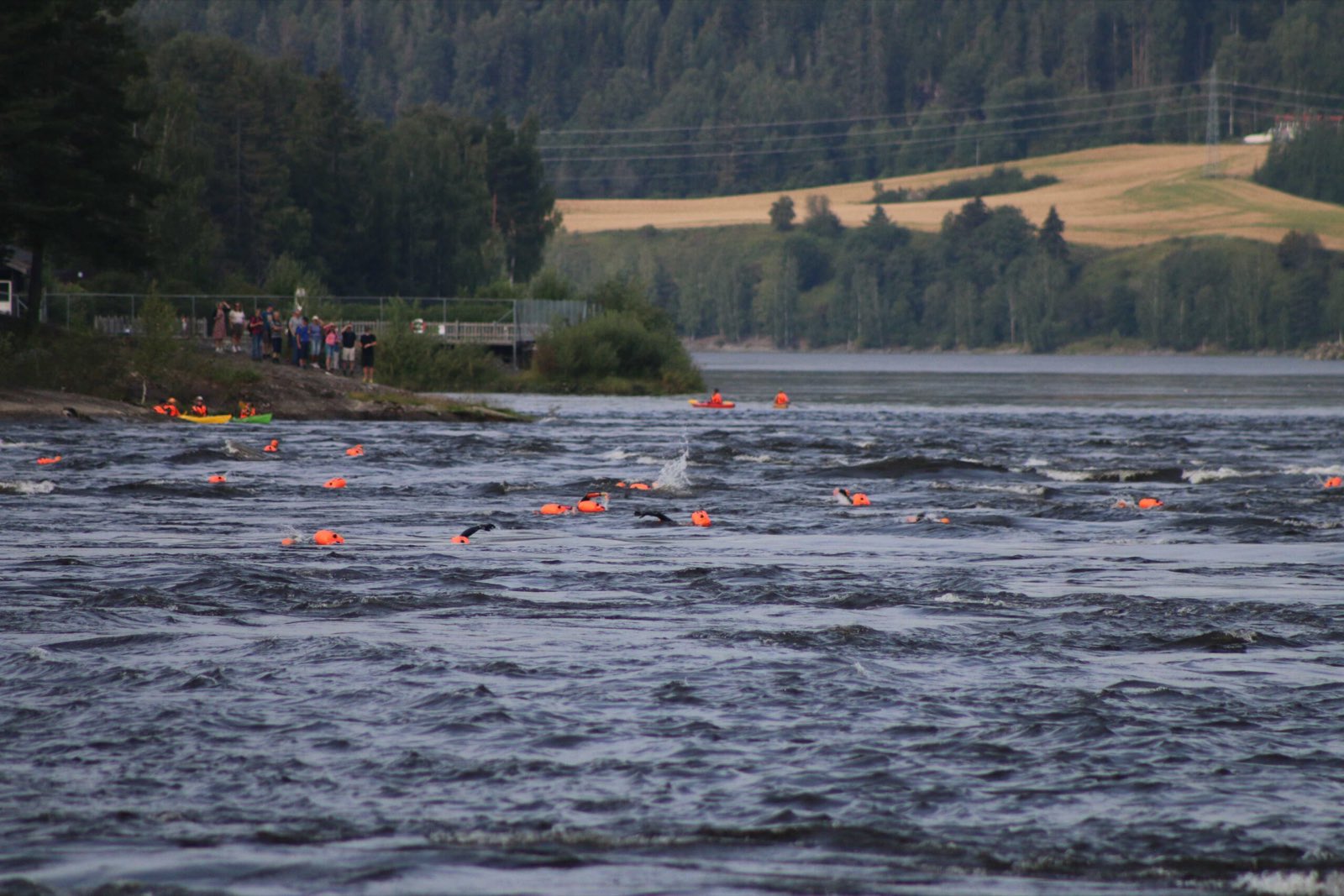
And the line, on the Glomma, is worth half the race. The river is very wide, and it is wise to study the route before diving in, asking for advice from veterans. Among them, you might be lucky enough to run into George Macpherson, a Scottish swimmer who hasn't missed an edition since the first one and who has an impressive knowledge of the river's fickle character. Knowing where the good current pulls, when to leave the center of the river, and how far in advance to set up the approach is more important here than elsewhere. On the Glomma, mistakes cost minutes. The approach channel to the finish (the one that brought logs to the Fetsund Lenser debarking plant) is on the right, and it is very easy to miss because the current pulls toward the center of the river, and staying to the side takes effort. The maneuver must be set up well in advance, and those who realize it too late find themselves crossing the current at ninety degrees to hit the entrance, knowing that going back, on a river like this, is not an option.

The weather, then, deals the cards. On sunny days, the wind often blows from the southwest, against the current: the surface breaks into low, frequent waves that break your rhythm and slap your face with every breath, with some inevitable swallowing of Glomma water (which, it must be said, is definitely good). The result is an almost mocking condition: on the surface, the water comes at you; underneath, it carries you. On gloomy or rainy days, the exact opposite happens: the current carries you like a cannon, completely in your favor, but visibility drops to about ten meters. And in both cases, the cold works on your flanks: in the long run, it bites, and your stroke loses power one degree at a time.
And then there is the real cold, the kind that doesn't work the way you expect. The Glomma has unpredictably cold water. The organizers explained it in an article that is a small lesson in limnology: when a strong wind from the south or southeast persists for days on Lake Mjøsa, the deep, icy water of this lake rises to the surface in the southern part of the lake and, entering the Vorma River, arrives in the Glomma in a couple of days. The result is that, even in mid-summer, the temperature can drop from 17-18 degrees to about 10 in a matter of days and, fortunately, rise just as quickly. The organization monitors temperatures and adapts the race if necessary (in 2025, they swam at 20.1 degrees with a flow of 1300 m³/s) and is even developing a forecasting tool to give the open water community advance notice. But for those chasing the crown, the message is simple: even on the day of the race, in August, you don't know what river you will find.
That the race is serious is also shown by the calendar: born in 2016 with a handful of pioneers at the start, today the GlommaDyppen attracts names like Sharon van Rouwendaal, the most successful Olympic open water swimmer, who brought her summer training camp to the Glomma in preparation for the race.
GlommaDyppen race card on Omniathlon last edition: August 1, 2026.The comparison
Three exams, one diploma
| UltraEbre 🇪🇸 | Flow des Gabarriers 🇫🇷 | GlommaDyppen 🇳🇴 | |
|---|---|---|---|
| Distance | 31 km | 33 km | 11 km (Fløter'n) |
| The river | Powerful current, then the delta kills it (or reverses it) | Placid and broken by locks | Turbulent, fickle, and cold |
| Water | ~26 °C | 18-22 °C | 17-18 °C… or 10 |
| The exam | Management: remembering to reach the last 10 km with energy | Rhythm: knowing how to restart eight times | Water reading and cold resistance |
The Ebro punishes those who start too fast, the Charente those who live by rhythm alone, the Glomma those who think that 11 kilometers in the dark waters of a Norwegian river are few. It is probably coincidental, but the almost perfect fit seems to be the result of a design of difficulty that explains why the register of aspirants is crowded and the club of those who have finished the series is so exclusive.
The Hall of Fame
The crown, as we said, has already found its first head: that of Chelsea Ning Lee, who after the Charente 2023 and the Thames 2024, closed the circle at the Ebro 2025, winning it in 5 hours and one minute. "Honestly, I didn't expect to win: just finishing the race was a huge achievement," she told the Malaysian newspaper The Star, which dedicated a portrait to her. Now, in Chelsea's sights are the 10 km Olympic race in Los Angeles 2028 and, one day, the English Channel.
Less than a month later, the trio in the current format—the one with the Glomma instead of the Thames—was completed by two others, on the same day and in the same race: on August 2, 2025, at the Fetsund Lenser finish line, the Belgian Olivier Delfosse (second overall in 1h40'00", after having won the Ebro a month earlier) and the Frenchman Guillaume Le Loher, of Puteaux Natation, twenty-second in 1h58'34".
Behind them, the register already counted very few swimmers at two out of three: it was clear that the next kings and queens would come from there. It happened sooner than expected.
On August 1, 2026, again at the Fløter'n finish line, the GlommaDyppen opened the Hall of Fame all at once: the series organizers welcomed seven new Kings of the Rivers at once. In the order they touched: Miguel Caro Van der Poel, second overall in 2h19'12"; Marc Thievent; David Garriga Falcó; Antonio Rotolo; Ruffo Paolini—yes, the one from the "first 20-kilometer trap": circle closed; Dennis Ushakov; and Grégory Lécrevisse, who co-founded the series and wanted to swim all three races himself.
| # | The trio club | Flow des Gabarriers 🇫🇷 | UltraEbre 🇪🇸 | Thames Marathon 🇬🇧 | GlommaDyppen 🇳🇴 | Crown |
|---|---|---|---|---|---|---|
| 1 | Chelsea Ning Lee 🇲🇾 | 2023 · 7h26'48" (10°) | 2025 · 5h01'02" (2°) | 2024 · no time | — | Jul 5, 2025 |
| 2 | Olivier Delfosse 🇧🇪 | 2023 · 6h47'43" (3°) | 2022 · 5h28'23" (2°) | — | 2025 · 1h40'00" (2°) | Aug 2, 2025 |
| 3 | Guillaume Le Loher 🇫🇷 | 2023 · 8h45'20" (22°) | 2025 · 5h45'22" (13°) | — | 2025 · 1h58'34" (22°) | Aug 2, 2025 |
| 4 | Miguel Caro Van der Poel 🇪🇸 | 2025 · 7h05'56" (9°) | 2021 · 5h59'34" (8°) | — | 2026 · 2h19'12" (2°) | Aug 1, 2026 |
| 5 | Marc Thievent 🇫🇷 | 2026 · 8h53'37" (22°) | 2024 · 5h50'46" (6°) | — | 2026 · 2h32'40" (11°) | Aug 1, 2026 |
| 6 | David Garriga Falcó 🇪🇸 | 2025 · 7h57'07" (15°) | 2024 · 6h04'38" (9°) | — | 2026 · 2h33'30" (12°) | Aug 1, 2026 |
| 7 | Begoña Shaw Herrero 🇪🇸 | 2025 · 3h44'43" (7°) 16 km | 2026 · 6h13'18" (18°) | — | 2026 · 2h43'37" (17°) | Aug 1, 2026 |
| 8 | Antonio Rotolo 🇮🇹 | 2026 · 9h47'12" (41°) | 2025 · 5h57'38" (17°) | — | 2026 · 2h52'15" (26°) | Aug 1, 2026 |
| 9 | Ruffo Paolini 🇮🇹 | 2026 · 8h43'03" (18°) | 2022 · 6h32'09" (13°) | — | 2026 · 2h53'30" (31°) | Aug 1, 2026 |
| 10 | Dennis Ushakov 🇷🇺 | 2025 · 9h36'31" (41°) | 2026 · 8h12'09" (53°) | — | 2026 · 3h08'39" (48°) | Aug 1, 2026 |
| 11 | Grégory Lécrevisse 🇫🇷 | — | 2024 · 6h55'18" (28°) | 2024 · 3h42'05" (18°) | 2026 · 3h55'05" (92°) | Aug 1, 2026 |
Omniathlon reconstruction by cross-referencing official rankings of individual races: 2,127 results, 1,647 distinct swimmers, eleven proclaimed by the series. Order by date of the race that completed the trio, in case of a tie in date, by placement in that race. For each river, the first completed edition is indicated, which is the one that counts as the finish. The Thames Marathon counted for the original trio, replaced by the GlommaDyppen from 2025; Chelsea Ning Lee's time on the Thames does not appear because that platform does not publish times or placements, and we will not invent them. In Cognac, Begoña Shaw Herrero swam the 16 km Apprenti Gabarrier and not the 33: the series proclaimed her anyway. Nationalities from official timing files of individual races.
Presenting the awards was Sharon van Rouwendaal, patron of the edition. And the promise for the reader is already written in the announcement: the next season will bring many new crowns.
And then there is the prize that does not appear in any Hall of Fame: descending the final stretch of the Ebro among the reeds and herons of the delta, passing under the stone bridges of the Charente in the green water of Cognac country, swimming among the old log locks of a Norwegian river. The crown is for very few; the privilege of swimming through such places, every summer, belongs to everyone who enters the water and accepts the challenge.
All three races of the series are in the Omniathlon open water calendar, with detailed sheets on courses, registration, and logistics.